

“Then I saw a new heaven and a new earth.”1
Giorgio Azzoni
Beyond. Metaphors of the Sacred
Friar Costantino Ruggeri’s stained-glass windows express the strength and depth of an art in keeping with the spirit of cultural, civil, and religious rebirth of the pre- and post-conciliar Church, as well as intimately Franciscan in the joyful simplicity of figures praising Creation and the Creator. They activate “a redemptive process that reconnects today’s world to that of primitive innocence and anticipates the world of eternal beauty.”2 Contemporary works, they are always conceived in dialogue with the shifting sunlight and the spaces that contribute to creating sacred places, and with the liturgical environments in which they participate. Therefore, their interpretation cannot be separated from their location and the relationships they establish with the context in which they are inserted.3
An initial phase of research into the expressive potential of glass saw Ruggeri create not so much the extensive transparent and colored surfaces that would become his most appreciated and widespread production, but rather concrete panels inlaid with crystals. This approach was pioneered in the large cross placed in the Madonna dei Poveri, a church built in 1954 by architects Figini and Pollini in a suburb of Milan. His association and friendship with Luigi Figini was a crucial experience in the artistic development of the young friar, who was ordained a priest in 1951 in the Lombard capital: a dialogue rich in consequences, not least because Figini, Ruggeri recalled, “soon wanted me as his liturgical consultant.”
Hanging in the church’s presbytery, the large cross in concrete and colored Murano glass harks back to Romanesque and Gothic wooden crosses in its installation, and to the jeweled crosses of the early Middle Ages in its structure. Far from imitative, it is nevertheless a courageously modern work. The concrete arms (like the church) are pierced and surrounded by rough crystals: some embedded, others protruding along the perimeter. The embedded ones appear predominantly opaque, like the body of Christ tragically dying. Passing through and enlivened by light, the protruding ones form a resplendent halo, a symbol of the Resurrection.
The cross of Santa Maria dei Poveri was a defining work in Ruggeri’s artistic career. A non-figurative composition, imbued with Franciscan simplicity and rooted in early Christian forms, its use of materials and its relationship with the church’s space provided a conceptual precursor to later liturgical furnishings and walls, to which colored crystals confer the positive entitas that Saint Francis recognized in all of Creation.
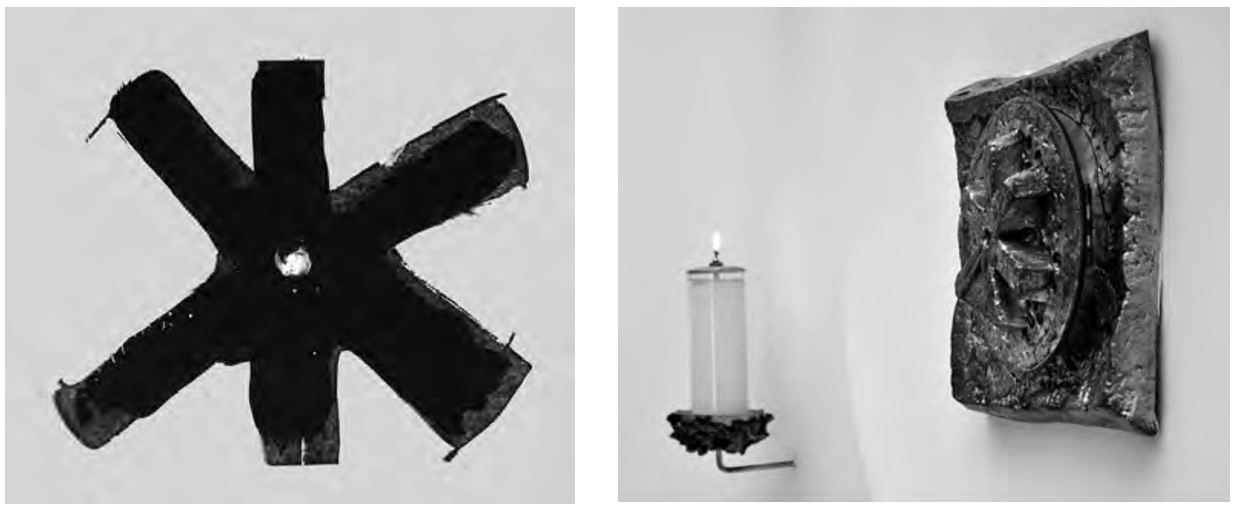
Brother Costantino Ruggeri, drawing, from Idem, Stenografie dell’anima, Piemme, Casale Monferrato 1991, p. 60
Tabernacle in the chapel of the O. P. Delbarba Rest Home, Adro (Brescia).
© Photo Giorgio Azzoni
“Living” stones (1 Peter 2:4-5), the rough, luminous blocks set in rough walls compose not Arte Povera but art inspired by Franciscan paupertas, a language of “poor ‘signs’ for the faithful of the ‘periphery,’ but true signs, free from any religious and liturgical triumphalism, and therefore intense and immediate.”6
From the very early 1960s, Ruggeri thus investigated the visual and expressive potential of colored crystals embedded in concrete, presented to light in various ways, with the aim of making them active protagonists of the liturgical space. To test its effectiveness, he created tests and models, working as a craftsman. Nazareno Fabbretti describes it thus:
On the ground, rough iron frames, lozenges, diamonds, irregular triangles. The friar, chalky and with blisters on his hands, assembles the colored crystals by hand on the fresh black cement, and everything takes on a lyrical form within the geometric shape of the frames. Unusual stained-glass windows are emerging that will cause a sensation. Others have already been created, shining on the walls of the chapel of the Mantua Seminary and the Franciscan Seminary of Varese, and in the church of Pioltello, near Milan.
Perhaps the most surprising outcome of these experiments was the apse wall of Sant’Adele in Buccinasco, built on the outskirts of Milan between 1964 and 1968 and described by the designers themselves as a church-workshop. Ruggeri also created and positioned the altar and tabernacle, which, with the backdrop, establish a unity of form and content. Painted black, the wall is dotted with holes that pierce it entirely, capturing the light from behind. Set in these openings, colored and shapeless blocks of glass become visually incandescent and, because the transparency reveals the tiny air bubbles trapped in the material, they resemble living organisms. Framed by large splays that sometimes organize them into groups, they form colorful constellations and, at the center, a double luminous halo: the inner, circular one surrounds the tabernacle (wall-mounted, originally transparent); the outer, elliptical one frames the altar. The glass stars are thus arranged to adorn the Eucharist, preserved and celebrated, identifying in Christ the absolute identity of movement (dynamis) and center (stasis). Sublimating matter and color, light bestows them with unexpected beauty and, at the same time, a “metaphysical” or metaphorical sacredness. Their luminescence seems otherworldly. The black starry wall suggests the sense of infinity felt when gazing at the night sky.
This and other works from the early 1960s developed in dialogue with the art of Lucio Fontana (with whom Ruggeri had established an artistic and personal relationship) as liturgical reworkings of the Spatial Concepts. In engaging with the most innovative expressions of contemporary Milanese art (Fontana’s Holes and Stones cycles, Roberto Crippa’s Spirals), the Franciscan artist initiated an aesthetic and thematic synthesis aimed at responding to and fulfilling the needs for artistic renewal that were sweeping the Church during the years of preparation and implementation of the Second Vatican Council.
In this direction, he reformulated, in a Christian key, artistic research that aimed to transcend traditional two-dimensional figuration (even through the use of earth, stone, and glass), giving form to an imaginary world of finite and infinite spaces. The beyond, which for Fontana was cosmic (infinite or void), becomes for Ruggeri the inexpressible, the universe filled with God. Fontana’s process (“I pierce, the infinite passes through there, the light passes through, there’s no need to paint”9) was also given a new meaning: infinity and light become manifestations of God.
I will seek my God beyond the stars10
In the late 1960s, abandoning the luminous holes, Ruggeri created his first surfaces in antique blown glass bound with lead.
In Sant’Antonio a Chiavari (1969), he imagines them flowing continuously beyond the pre-existing ogival mullioned windows, as if each framed the same landscape-sky. Alongside abstract figures (shapes and grids of orthogonals), synthetic citations of recognizable elements appear, the first nucleus of a vocabulary of symbols destined to progressively expand: “a poem resolved into rigorous, essential figurations, yet rich in extraordinary imagination: moon, stars, flowers, animals, lights, very few shadows: all the life of the universe gathered, joyfully, around the altar, full and total life that bursts into the temple to participate in the Eucharistic mystery.”11
In the mullioned windows of the apse, the forms become sparser and a luminous white dominates. Saint Anthony marked a turning point, as Ruggeri began to conceive of stained glass windows as figurative laude, an expression of a joyful interpretation of Creation. At this stage, he seemed to draw inspiration from European abstract art and Paul Klee, not only for certain formal solutions (which he soon abandoned) but also for the desire to recreate invisible worlds that lie within and beyond the visible. Klee wrote in his Diaries: “Everything that happens is nothing but symbol. What we see is proposition, possibility, expedient. The authentic truth, at its foundation, in principle, is invisible.” The artist’s task is, indeed, to make the invisible visible.
Paul VI, addressing artists in 1964, expressed this mission in a Christian sense, stating:
Our ministry needs your collaboration. Because, as you know, our ministry is to preach and make accessible and comprehensible, indeed moving, the world of the spirit, of the invisible, the ineffable, of God. And in this operation, which transposes the invisible world into accessible, intelligible formulas, you are masters. It is your profession, your mission; and your art is precisely that of plucking from the heaven of the spirit its treasures and clothing them in words, colors, forms, accessibility.
The prerogative of art, the pontiff added, is to make “the world of the spirit accessible and comprehensible—but at the same time—to preserve in that world its ineffability, the sense of its transcendence, its aura of mystery, this need to reach it with ease and effort at the same time.”
Ruggeri responded to the Pope’s appeal with a heightened sense of responsibility as a Franciscan and a priest, pursuing a contemporary art capable of “drawing its treasures from the heavens of the spirit”14 to make them accessible and comprehensible, while preserving their ineffability. He did not adopt abstract forms but figures drawn from the sensible world which, however, composed in landscapes that were never descriptive or narrative, referred to something else and beyond. Indeed, he declared: “But beware of stopping at ‘representation.’ We must enter into the vision, that is, into the rhythms and vital forces, into their very being.”15
He reconsidered the signs that had attracted him in previous years: the prehistoric rock carvings of the Camonica Valley (reworked in his pictorial studies of the 1950s) and the epigraphic symbols of the Roman catacombs (studied for his thesis at Brera). Mindful of the simple, colorful joy of Klee’s landscapes and gardens in watercolors, fascinated by the dynamic freedom of the white doves in the graphic works of Braque and Matisse, and the naive fantasy of Chagall’s suspended figurations, he developed, in just a few years, a language of original forms and compositions. The intimate, reserved, and colorful atmosphere of Matisse’s stained-glass windows in the Chapel of the Rosary in Vence was certainly illuminating, but he sought to transcend their (albeit very delicate) decorativeness to be more incisive, as his vital and artistic energy demanded. He also felt the need to correlate his interventions with the surrounding environment, leading him to conceive the Mystical Spaces and to design churches with the architect Luigi Leoni.
His vocabulary of forms found exemplary landscapes in the stained-glass windows created from the second half of the 1960s: compositions of colored leaded panes, sometimes entire walls, capable of fully enhancing the expressive power of light.
Thus, for example, in the church of the Holy Guardian Angels in Milan, for which he also created the baptistery (with blocks of crystal set into the walls). Unlike Matisse in the chapel of Vence, he did not adapt to the sequences of vertical openings by repeating a finished decorative motif, but created continuous and transversal compositions, like visions framed by the windows. He designed them with careful verification16 and, to achieve formal and compositional synthesis, he adopted in his study sketches a technique similar to that of the popes.
rs gouache découpés by the French master.
The complex and not always simple iconographic program develops the theme of the contrast between evil and good, death and life, darkness and light: the sun rises from the darkness, a small flower from the barren earth; a white dove flies before the beast of the Apocalypse. The cross and the crown of thorns (both blood-red) convey Redemption, symbolized by a fresh blue line that crosses and unifies the scenes. At the corners of the two lanterns, evanescent shapes and colors allude to the heavenly Jerusalem.
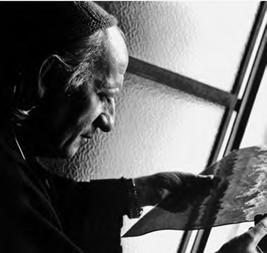
Fra Costantino in his studio with a sample of blown glass
@ Photo Archive of the Frate Sole Foundation, Pavia
Multiple and dense in the older stained-glass windows, over the years the figures expand to become sparse presences, of strong chromatic intensity, against depths of blue and azure, traversed by the variegated and subtle texture of the lead structure. In the vast glass walls of the great Roman Sanctuary of Divine Love (1998), where every barrier between interior and exterior, between architecture and space, between real and celestial horizons is revoked, a red sun with a stylized chrysmon and a grandiose orange sun, a Red Cross on an ethereal white cloud, and the words (very rare in Ruggeri’s work) “Ave Maria” prevail.
Landscapes of symbols
Saint Francis’s Canticle of the Creatures was a constant and ongoing theme for Ruggeri, as well as an ethical foundation and aesthetic reference.
In the stained glass windows of the early 1860s, he inserted prevalent references to the opening verses: to “Brother Sun” and to “Sister Moon and the Stars”; in the Chiavari windows, he added “Aree and Nubilo and Sereno,” “our Mother Earth, who sustains and governs us, and produces various fruits with colorful flowers and grass,” and “Sister Water, who is very useful and humble and precious and chaste.”18 As in the Canticle, man is absent, a spectator who praises the Creator in creatures.
“In my conception, everything is ‘sacred,’ everything is ‘mystical’ to the extent that it does not exclude the ‘natural,’ the pre-existing,”19 Ruggeri stated. To “help man, in short, to intuit or find God,”20 everywhere and joyfully, he evokes heaven, earth, and water inhabited by the sun, moon, stars, clouds, birds, and flowers, whose forms, illuminated by light, inspire wonder and joy. Unexpected juxtapositions, discrepancies in proportion, anomalies or chromatic intensifications, and spatial contradictions suggest that the meaning of these presences cannot be exhausted in the composition of a landscape, even more so because of the irruption of crosses and red tongues, or asterisks and taus signs. They are, instead, landscapes of symbols, and the symbol “gives one pause for thought.”21 Indeed, with Cassirer,22 it is the essential organ of thought and continually interrogates. Furthermore, “Ultimately, the symbol is indispensable for man to complete his own experience of the sacred.”23
The symbols in Ruggeri’s stained-glass windows are inspired by the great code of the Bible.24 They are metaphors of the human condition that speak a universal language, ancient and contemporary, not limited to the aesthetic dimension alone. Unlike many signs in twentieth-century art that arose from individual and biographical sensibilities, they draw on a common heritage to convey a sense of the Christian and Franciscan world.
This very horizon explains the juxtaposition of otherwise paratactic elements (for example, the crown of thorns or the cross placed before the sun) and the recurring contrasts between dark and light areas, between shadowy beings and the white dove. The compositions do not conceal conflicts and lacerations but resolve them in an eschatological perspective born of the hope of Redemption as the ultimate union, even of opposites. Ruggeri, in fact, finds “the golden thread that binds biblical symbols together, also considering the fact that they have their apex precisely in Christ, the greatest possible ‘symbol’: he, in fact, unites in himself the two extreme poles and all possible meanings, those of humanity and divinity.”25
Light is a powerful symbol and the very reason behind the stained glass window. The Christian is a “child of light” (1 Thess. 5:5; Jesus affirmed, “I am the light of the world; whoever follows me will not walk in darkness, but will have the light of life” [Jn 8:12]. Masterfully intercepted as in Gothic cathedrals, the light that Suger defined as mirabilis et continua is not only an indispensable operator but also an expressive instrument, since “Contemporary man loves light, is in search of light. And light has no boundaries; it is inexhaustible like that of the soul”26. Regardless of the figurations it passes through and illuminates, it gives the (mostly simple) interiors a sacred dimension, since “it transforms all the environments into ‘mystical spaces’, it gives form, immensity and sweetness together”27. To describe its radiation that transfigures the spaces, Ruggeri added:
Have you ever observed the sky at dawn? It becomes immense, truly infinite. […] And in that moment of light and mystery, the stained-glass window “kidnaps” him outside the temple, introducing him naturally, as if into a total dimension, divine as well as human. I won’t tell you what happens when the disk of the sun appears radiant and blissful on the horizon. From the large windows, the sky opens up and a river of light bursts in, trickling onto the floor, while the shadows flee into the corners and you can no longer see them. The pillars and columns light up, lighten, become transparent, and you have the impression that the church itself is rising, lifted by another tide of colors. At night, it is the moon that leads the dance.
Passing through the stained-glass windows, the light covers surfaces, furnishings, ornaments, and people with a colored cloak, projecting shifting and informal spots whose clarity, shape, size, and placement change with the hours, the seasons, and the weather. Anyone who enters or pauses in the church is deeply involved, both emotionally and physically, when directly struck by the projection. luminous. The spectacle of bright colors (in the glass) and reflections (from the glass) produces first of all a joy of the senses that becomes prayer. The light is, furthermore, enhanced by calculated contrasts of quality (between pure and tertiary colors, warm and cold, clear and dark, transparent and opaque) that oppose it to darkness, as a figure of the victory of good.
and on evil, of life on death.
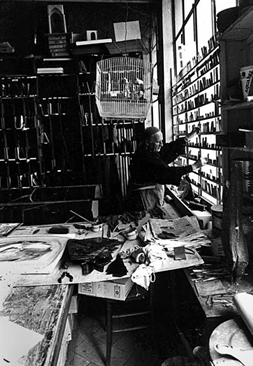
Brother Constantine in his study, choosing from stained glass samples.
@ Photo Archive of the Frate Sole Foundation, Pavia
For Ruggeri, the place richest in light is the baptistery, since baptism is the sacrament of light and the baptized are “illuminated” by it. 29 He orients the space and the windows to capture the first light of day; he often directs it onto the water in the basin. The baptisteries themselves sometimes become “lighthouses” that illuminate churches, even when they are pre-existing and shadowy.
The sun is a constant subject in stained glass windows: a large yellow or orange disk that often contrasts with dark surfaces. In some, it is also white: the Eucharistic host.
An indispensable source of life, an expression of universal movement and the cyclical nature of time, it is a divine symbol in all religions. even for Saint Francis, who calls him “beautiful and radiant with great splendor” and adds “of you, Most High, he bears a sign.”31
In Canto XI of Paradiso (v. 50), Dante compares Francis himself to a sun that, like Christ, rises in the East. Thomas of Celano noted: “The presence, or even the mere fame, of Saint Francis truly seemed a new light sent from heaven at that time to dispel the murky darkness that had invaded the earth, so that almost no one could discern the path to salvation.”32
Also in the Vita Prima, Thomas of Celano described the saint as follows: “When he gazed at the sun, the moon, and the stars of the firmament, his soul was flooded with joy.”33 The reference is to Isaiah (9:2) who, celebrating God as the light that illuminates “those who dwelt in a land of deep darkness,” says: “You have multiplied joy, you have increased gladness.” The same joy is produced by Ruggeri’s glassy heavens, where the sun is often joined by “sister Moon and the stars,” which the Song of Songs calls “clear, precious, and beautiful.”34
Among the stars, the morning star has always had a particular symbolic value, appearing brightly before dawn and announcing the new day. In Revelation (22:16), Jesus declares himself “the radiant morning star”;35 the Easter liturgy celebrates him as “the morning star, that star that never sets.” In 2 Peter 1:19, the words of the prophets are compared to “a lamp shining in a dark place until the day dawns and the morning star rises in your hearts.” The morning star is, once again, a figure of Francis, who “shone like a bright star in the darkness of the night and like morning light spread across the darkness.”36 Ruggeri depicts it as five-pointed, large, and yellow, distinct and preceding the other elements, anticipating the day. Taken from the Second Life of Thomas of Celano, the following vision of Francis’s soul ascending to heaven seems to be the caption for his stained-glass skies: “It was like a star, but with the grandeur of the moon and the splendor of the sun, and it flew over the expanse of water, carried aloft by a small white cloud.”37 The water, not always distinguishable from the sky due to its dense, intense blue, introduces a lower horizon into the stained-glass windows that dialogues with the celestial immensity.
In his baptisteries, Ruggeri emphasizes their concrete presence by designing large basins (when possible with a continuous flow) exposed to light: in the churches of the Sacred Heart in Abano Terme, the Tabernacle in Genoa, and Saints Clement and Guido in Prato Centenaro in Milan, these basins are placed next to the stained glass, creating continuity between the brightly colored shapes on the walls and their reflections, which the water makes more evanescent and mobile.
Another recurring figure is the dove: in flight, it stands free above everything else and dominates evil. In small spaces, it sometimes occupies a separate section, often a tondo that serves as a rose window. Enormous, on the counterfaçade of Sant’Alessandro in Pavia (where it is juxtaposed with a delicate blue tau, a cloud in the sketch), it dominates the grandiose blue sky to defeat the dark forces of evil. It is often contrasted with a dark core; in the church of the Guardian Angels in Milan, it is the beast of the Apocalypse. A biblical symbol of beauty, readiness, and peace, it is, above all, a figure of the Holy Spirit descending upon Jesus after his baptism. In connection with this episode, Ruggeri also included it in the stained-glass windows of baptisteries; in the one in the church of San Basilio in Milan, it appears in a flock. For Ruggeri, man must “possess ‘the eyes of the dove’ to see the tremor of God’s face.”38
The dove is also a figure of the soul of the Franciscans.39 “Forgetting things past, they always reach forward with untiring steps, and fly like clouds or like doves toward their dovecotes, taking every care and precaution to prevent death from entering.”40 Innocent and free, they move through the world, crossing every boundary to bring peace and salvation.
Another symbol present in the stained-glass windows is the tau. The last letter of the Hebrew alphabet, it designates God by replacing his unpronounceable name (Wisdom 14:21) and, again
Similar to the last letter of the Greek alphabet (omega), it refers to perfection. Because of its cross-shaped form, it symbolizes the crucifixion, which Ruggeri often depicts in red. Saint Francis opened and signed letters with the tau. The Major Legend narrates:
And in reality, the saint had great veneration and affection for the sign of the Tau. He often recommended it in his speech and wrote it with his own hand under the letters he sent, as if his mission consisted, according to the prophet’s saying, in marking the Tau on the foreheads of men who groan and weep, sincerely converting to Christ.
In this sense, it is a concrete sign of salvation, since the Lord had it placed on those who needed to be preserved from punishment, commanding, “Go through the city, through the midst of Jerusalem, and mark a tau on the foreheads of the men who sigh and weep over all the abominations that are done in it” (Ezekiel 9:4).
Christ’s saving sacrifice is evoked above all by the large crosses42 and by red tongues that burst through the elements (of evil), opening a path to life and hope.43 The flowers and buds that sometimes blossom within dark contexts take on a similar meaning, an image of life reborn.
Finally, the chrismon (chi rho) is a Christological symbol, an emblem of the Resurrection and the triumph of Christianity. Ruggeri translates it into a synthetic six-rayed star, or eight when combined with the cross, almost an asterisk, predominantly red in color, which, shining like a star, dominates the heavens, overlapping with other elements. Ruggeri’s large stained-glass windows thus act, with artistic and liturgical intelligence, on the viewer (and the faithful) on different levels. Producing joy for the senses, they contribute to creating beautiful and welcoming churches in which everyone (believer or not, Christian or not) can sense the presence of the sacred and gather in reflection or prayer. According to Ruggeri, those who enter sacred spaces “must, in fact, feel like they are in the house of the Father, in a peaceful and happy place.”44 They are, moreover, a lofty and concise ornamentation of the liturgy but also a luminous “reliquary” supporting the Word.
They then stage landscapes of symbols that speak a universal language, drawing on a shared imagery of archetypal signs that transcends and encompasses temporal, geographical, and religious boundaries. Their conception of Nature and History, however, is Christian and points to Christ as the path to Salvation.
Finally, a strong Franciscan influence emerges, not only in the positive consideration of Creation, but also in the citation of a specific imagery, referring to Saint Francis and the mission of his Order. The very idea of beauty is mediated by the saint, as Ruggeri suggested: “But beauty will be so beautiful that it will be necessary to guarantee it to everyone, if we are not capable of looking at it with the eyes of Saint Francis, poor in all consumption, rich in all goods.”45
1 Apocalisse 21,1. Nelle vetrate di Ruggeri la Gerusalemme celeste è continuamente suggerita ed evocata. Nel riferimento a fonte biblica, il presente testo adotta le convenzioni di citazione cattolica in uso.
2 S. Nicolosi, Medioevo francescano, Borla, Roma 1983, p. 50.
3 In considerazione di tale legame con il contesto, questa indagine è stata preceduta dalla visita di numerosi siti (soprattutto lombardi e veneti) e (ove possibile) dal dialogo con testimoni. Poiché i casi citati sono esemplificativi di un repertorio ricchissimo, distribuito in molte regioni italiane e non sempre facilmente accessibile, si affida ad ulteriori studi il proseguimento della ricerca.
4 Cfr. C. Ruggeri, in N. Fabbretti (a cura di), Soltanto un fiore. Genesi di un artista cristiano, Marietti, Città di Castello (Perugia) 1990, p. 43.
5 Ruggeri realizzò, in molte occasioni, croci bifacciali che presentano il Crocifisso sul verso e, sul recto rivolto ai fedeli, una Risurrezione astratta. Li denominò Croci gloriose, rifacendosi agli esemplari altomedievali che, oltre al sacrificio, rievocavano la parusia, presentando il mistero della croce nell’unità dei due aspetti di morte e risurrezione. Il riferimento tipologico è alle croci gemmate medievali, di cui due preziosi esemplari si conservano a Brescia, vicino al paese natale Adro: la Croce di Desiderio (IX secolo) in San Solario presso il Monastero di Santa Giulia (ora Museo della città) e la Croce del Campo (XI secolo) in duomo vecchio.
6 N. Fabbretti, Povertà e bellezza nella chiesa di S. Adele, in “Parrocchia di S. Adele” in Buccinasco, p. 3, presso Archivio Fondazione Frate Sole, Pavia.
7 N. Fabbretti, Un frate ha scoperto sulla luna i segni della sua stessa arte, in “Il Giornale d’Italia”, 29. 30 settembre 1964, presso Archivio Fondazione Frate Sole, Pavia.
8 Soluzioni analoghe si trovano nella chiesa di Sant’Anselmo Vescovo di Lucca a Malcantone di Sermide (Mn), nella chiesa del Seminario francescano di Figline Valdarno (Fi) e nel battistero della chiesa dei Santissimi Angeli Custodi di Milano.
9 C. Lonzi, Autoritratto, De Donato editore, Bari 1969, p. 170.
10 P. Klee, Poesie, Abscondita, Milano 2000, p. 81.
11 N. Fabbretti, Finestre su Dio e sull’uomo, in “Il Santo. Periodico del santuario di S. Antonio a Chiavari”, febbraio 1970, pp. 11-12, presso Archivio Fondazione Frate Sole, Pavia.
12 Paolo VI, Omelia della Messa degli artisti nella Cappella Sistina,7 maggio 1964,in https://www.vatican.va/content/paul-vi/it/homilies/1964/documents/hf_p-vi_hom_19640507_messa-artisti.html.
13 Ibidem.
14 Ibidem.
15 Cfr. C. Ruggeri, in Fabbretti (a cura di), Soltanto un fiore cit., p. 130.
16 Molti studi, collages colorati e modellini tridimensionali con carta e vetro colorato per verificare la reazione delle composizioni artistiche con la forma dello spazio destinato ad accoglierle, sono conservati presso la Fondazione Frate Sole di Pavia.
17 Il tema ritorna anche nelle vetrate della lanterna della chiesa di Santa Maria a Darfo (Bs) e, nel presbiterio della chiesa di San Bernardo di Chiaravalle a Roma.
18 Francesco d’Assisi, Il Cantico delle creature, in Fonti Francescane, a cura di E. Caroli, Edizioni Messaggero Padova, Padova 1996, (in seguito, FF.), p. 178.
19 Oltre vent’anni di serio impegno. L’intervento di padre Costantino Ruggeri, in “L’Avvenire”, 28 maggio 1978, p. 7. presso Archivio Fondazione Frate Sole, Pavia.
20 Ibidem.
21 P. Ricoeur, Il simbolo dà a pensare, Morcelliana, Brescia 2002.
22 E. Cassirer, Filosofia delle forme simboliche, vol. 1 (Il linguaggio), La Nuova Italia, Firenze 1996, 20.
23 J. Ries, Simbolo. Le costanti del sacro, Jaca Book, Milano 2008, p. 2.
24 G. Ravasi, Parlava loro in parabole. I volti diversi del simbolo secondo la Bibbia, in Fra C. Ruggeri, Stenografie dell’anima. Simboli epigrafici delle catacombe, Piemme, Casale Monferrato 1991, pp.145-166.
25 Idem (a cura di), Presentazione all’edizione italiana di M. Lurker, Dizionario delle immagini e dei simboli biblici [Monaco 1987], Edizioni Paoline, Cinisello Balsamo 1990, p.VII.
26 C. Ruggeri, in Fabbretti (a cura di), Soltanto un fiore cit., p. 81.
27 Ivi, p.121.
28 Ivi, pp. 121-122.
29 “Questo lavacro si chiama ‘illuminazione’, poiché coloro che comprendono queste cose sono illuminati nella mente. E chi deve essere illuminato viene lavato nel nome di Gesù Cristo, crocifisso sotto Ponzio Pilato”. In Giustino, Apologia 1, Il battesimo, LXI, 8.
30 J. Ries, Il sacro nella storia religiosa dell’umanità, Jaca Book, Milano 1981, nota 26, p. 95.
31 Francesco d’Assisi, Il Cantico delle creature, in FF., p. 178.
32 Tommaso da Celano, Vita Prima, cap. XV, in FF., p. 441.
33 Ivi, cap. XXIX, p. 474.
34 Francesco d’Assisi, Il Cantico delle creature, in FF., p. 178.
35 Anche Ap 2,28.
36 Tommaso da Celano, Vita Prima, cap. XV, in FF., p. 442. L’immagine, ispirata alla Bibbia (cfr. Sir. 50,6-7) e alla liturgia, fu tema del Sermone di Gregorio IX in occasione della canonizzazione di Francesco.
37 Tommaso da Celano, Vita seconda, cap. CLXIII, in FF., p. 727.
38 C. Ruggeri, in Fabbretti (a cura di), Soltanto un fiore cit., p. 71.
39 C. Frugoni, Quale Francesco? Il messaggio nascosto negli affreschi della Basilica di Assisi, Einaudi, Torino 2015, pp. 333-337.
40 L’Ordine e la predicazione dei frati minori, in “Historia Occidentalis”, 1. II, c. 10, Cronache e altre testimonianze non francescane, in FF., 1911.
41 Bonaventura da Bagnoregio, Leggenda maggiore, in FF., pp. 867-868.
42 La più possente si trova nella controfacciata della chiesa di San Paolo in San Rocco a Palazzolo sull’Oglio (Bs).
43 Di grande e drammatico impatto è la rossa colata di sangue che nasce dal sole nella vetrata della chiesa del Sacro Cuore di Abano Terme (Pd) e che colpisce la montagna, fertilizzandola, nella cappella delle Clarisse a Bienno (Bs).
44 C. Ruggeri, in Fabbretti (a cura di), Soltanto un fiore cit., p. 123.
45 Ivi, p. 107.