

Roberta Manara
The tenth anniversary of Father Costantino Ruggeri’s death was an opportunity for the Frate Sole Foundation to commemorate him with a hybrid exhibition, documenting both his love for Pavia and his passion for photography. Yesterday, Pavia was supposed to be the name of the exhibition the artist-friar had planned to inaugurate in the exhibition spaces of the Visconti Castle from May to July 1984. He had been working on it for over a year, collecting a diverse collection of iconographic material, but for unknown reasons, he was unable to realize it. To realize this ambitious exhibition project, an iconographic reinterpretation of the city, his close friend Guglielmo Chiolini had donated a corpus of 200 large-format black-and-white positives (24 × 30 cm) of the so-called “Old Pavia.” These photographs, taken by himself and other photographers (Tollini, Nazzari, Valli, Moisello, Trentani, etc.), date back to the late nineteenth century. These images, images Costantino found striking for their sweetness, almost as if evoked by dreams. The friar, who had repeatedly emphasized his debt of inspiration to Pavia, his adopted city, told his fellow friar Fabbretti:
The city immediately proved perfectly suited to my feelings and temperament. It made you listen, look, dream. You can’t rush through Pavia. […] Pavia always enchants you, in all its spaces of shadow and light, of history and living people, on the red pinnacles of its towers and the spires of its churches. It enchants above and below ground; yes, even in the crypts and cellars. […] It is no coincidence that I built my studio in a bright and barbaric attic-cum-grain, where masks and beams, geraniums and birds overlook the alleys and rooftops, pause and depart.
The aim of the exhibition he wanted to organize was not only to express gratitude to a city that had warmly welcomed him, but also to hand down to future generations, through unique artistic and documentary testimonies, a tangible memory of this extraordinary past. The fortunate rediscovery of the corpus of images of ‘Old Pavia’ (during a reorganization of the Foundation’s archive) inspired the exhibition “Era Pavia nel cuore di fra Costantino, Guglielmo Chiolini, Mino Milani” (Pavia in the heart of Fra Costantino, Guglielmo Chiolini, Mino Milani). The exhibition, held in 2017 in the prestigious municipal setting of the Broletto “Spazio Immagine Design Rossana Bossaglia,” developed along two parallel tracks: the desire to realize the Franciscan friar’s wishes on the tenth anniversary of his death, but also to showcase, through a selection of his previously unpublished photographs, another aspect of this eclectic, strong-willed, and multifaceted personality: his passion for photography, an art he personally practiced, achieving extraordinary results, from the 1960s onwards. Thus, unstoppable, he embarked on a new adventure and once again put his vision into practice:
The world needs to rekindle, like dawn, like spring. But to rekindle and flourish, it needs beauty, imagination, and creativity […] True fidelity to the past, to society, to the Church, and to the Order, lies in the freedom to continually renew oneself.
It seemed methodologically correct, in approaching the iconographic survey of Pavia, to begin with a historically defined core (available at the Foundation and, in its entirety, in the G. Chiolini Historical Archive), from which lesser-known images of the urban fabric from different historical periods were selected. The exhibition itinerary began, according to Costantino’s wishes, with an overall view of the city from Borgo Ticino, continuing along the inner ring road, bordered to the south by the river, with the gates and bastions that would soon be demolished, and concluding in the picturesque alleys of the old town center. The possibility of juxtaposing the black-and-white positives from Studio Chiolini with Costantino’s color photographs seemed a happy and stimulating combination to approach the city with an unusual eye, where the added value was represented by the writings of their mutual friend, the renowned Pavia historian and writer Mino Milani. This “writer of today,” whom Gianni Rodari believed capable of “narrating through images” by evoking the rhythm of actions, is the concrete expression of a deep attachment to the city of his birth, from which he never wanted to leave, and in which he set many of his stories.
We were helped, in this journey through images, by the always lucid and witty words of the great Pavia master, whose literary sensibility perfectly complements the artistic sensibility of the two photographers – who recognize in Father Costatino an artist who, going beyond his own art and projects, managed to express both reality and dreams, remaining consistent with this synthesis from the very beginning or at the end. There was in this talent, a greatness, an unparalleled harmony between the Franciscan father and Pavia. The exhibition did not seek to offer a nostalgic and melancholic reading of the city, nor a comparison between yesterday and today, but rather to ideally re-establish a dialogue between three great masters and their Pavia. The topos was the ‘Pavesità’, the common thread the devoted and unconditional love for Pavia, shared by three undisputed local personalities, linked by a unique friendship and elective affinities: Guglielmo Chiolini, Father Ruggeri, and Mino Milani, three harmonious and complementary voices who contributed, each in their own personal and specific way, to celebrating and enhancing Pavia, seeking and consolidating the concept of beauty. Costantino, in particular, believed that beauty, so central to his life, was a communicative tool capable of speaking a universal language across time and space and, to quote Dostoevsky, capable of saving the world. A tenacious personality in study and research, a lover of beauty and the sublime, he always sought to surround himself with new stimuli, never satisfied with the results achieved, tirelessly open to grasping all the unexplored riches of knowledge. This seems to be indicated by the over 600 color slides, dedicated by the artist-friar to Pavia alone (the entire collection totals 10,000 shots), which enrich and complement his varied and fruitful artistic production, further clarifying the stages of his technical and expressive research, far removed from traditional patterns, stereotypes, and the impositions of the art market. While in some photographs he offered an iconographic reinterpretation of the same places explored by his friend Chiolini, in others his curious gaze focused on the particular, the “extravagant” detail, the objet redécouvert, the defenseless animal, be it a dog, a bird, or a cat, often camouflaged in the shot. His attention was drawn to hidden glimpses, picturesque corners, almost dreamlike atmospheres captured at different times of day and in different weather conditions: fog, rain, snow, dawn, dusk, twilight, evening, night. But also to roofs, chimneys, hanging laundry, wall facings, plaster, marble, brick, floors, cobblestones, railings, doorways, old staircases, still lifes, the river, towers, panoramas, old walls, familiar and hidden corners, recognizable and unrecognizable objects, ancient memories. Even in photography, Father Costantino did not renounce his highly personal stylistic signature. He loved images that exhibit a non-trivial approach, with unusual angles; he favored geometry, but not symmetry, views from above, and carefully crafted framing. In these, the most artistically significant artifact does not dominate frontally, but serves as a backdrop; indeed, darkness and obscurity are often given ample space in the foreground. Black, or rather, darkness, is prevalent and omnipresent, contrasting with the ancient red of the bricks, typically from Pavia. He frequently placed a sort of diaphragm between himself and the photographed subject: a grate, an arch, barbed wire, a shadow, a wall, a phytomorphic frond… which seem to fade and detract from the ‘real’ subject, relegated to the background. The evocative shots of the narrow, cobbled alleys, with their intense brightness, underscore the affinity of interests and intentions with his friend Chiolini, who, like him, did not often photograph the human element, present only in very few shots, but focused primarily on the artistic object itself. These are thoughtful, captivating, and often mysterious images, which reveal the uncommon sensitivity of Costantino, who daydreamed and constantly envisioned new atmospheres and spaces. His photographs, characterized by a highly personal lyricism and a vision of the world derived from the Canticle of the Creatures, convey the Pavia of the heart and soul.
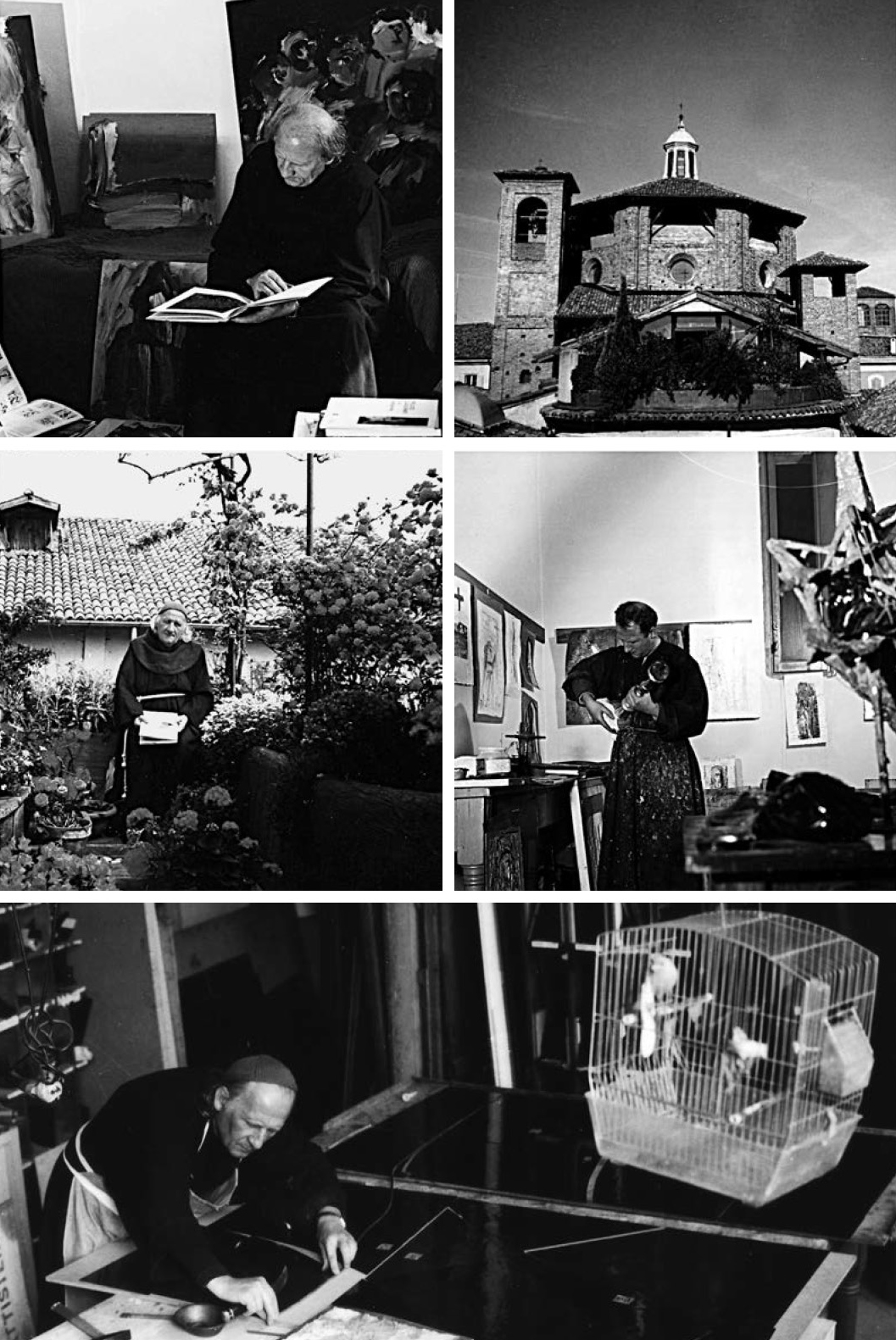
Father Costatino in the study of the Canepanova convent in Pavia; view of the study from the outside; the father in the study’s garden; at work in the atelier cell; in the glassworks
1 C. Ruggeri, in N. Fabbretti (a cura di), Soltanto un fiore. Genesi di un artista cristiano, Dies, Milano 2001, II ed., pp. 62-63.
2 Era Pavia nel cuore di fra Costantino, Guglielmo Chiolini, Mino Milani, a cura di R. Manara, catalogo della mostra (Pavia, Broletto, Spazio Immagine Design “Rossana Bossaglia”, 15 dicembre 28 gennaio), Pavia 2017.
3 Ivi, p. 34.