

A distinctive trait of Father Costantino was his joy in forging friendships and sharing exhilarating artistic experiences. Just as Saint Francis of Assisi lived in communion with his brothers, so Father Costantino, when he decided to embark on a journey of evangelization through art, loved to surround himself with men who, sharing his aspirations, engaged with him in the same commitment. He never disdained any connection; indeed, he engaged with men and women from the most diverse social and cultural backgrounds, seeking to build paths of dialogue, foster fraternity of choice, and further develop the artistic and faith-based direction he envisioned. In the postwar period, finding himself in Milan amid a general reawakening of hope, he frequented the studios of painters, sculptors, and architects whose works showed him a direction for modern art that also reflected lofty spiritual values: Mario Sironi, Luciano Minguzzi, Giorgio Morandi, Lucio Fontana, Carlo Carrà, Roberto Crippa, Luigi Figini and Gino Pollini, Filippo De Pisis, Arturo Tosi, Marino Marini, Bruno Cassinari, Giorgio de Chirico, Emanuele Cappello, Sergio Dangelo, and Ottone Rosai. Every art form fascinated him; he was also drawn to music and poetry: he was a friend of Salvatore Quasimodo and Eugenio Montale. He paid particular attention to young people. After his experience in the Milan oratories in the 1950s, in the Canepanova convent in Pavia, starting in the 1960s, he began a process of growth with the group of altar servers for liturgical service, engaging them in clay modeling, plaster casts, wood and cardboard models, and ceramics. He established an art workshop in the historic veranda of the convent, once a fifteenth-century noble residence built on medieval foundations, a hotbed of works that came to life under his expert direction. To this end, he also needed to establish contact with companies and figures outside the convent: for bronze works, he liaised with the De Andreis foundry in Quinto de’ Stampi (Milan); for the finishing of church furnishings, he worked with the brothers Aldo and Leopoldo Giampieri of Rome. In Pavia, he also frequented various carpenters’, blacksmiths’, and artisans’ workshops, creating works in wood, iron, and steel, such as Gambuzzi, Camillo Fraschetti, Vincenzo Mangiarotti, and Rino Roveda. In the city, he benefited from associating with simple, familiar people, which allowed him to relive the unforgotten charm of his hometown of Adro and of life in the Franciacorta countryside, near Lake Iseo. Above all, he maintained a strong bond with his mother, Rosina, and his father, Angelo. A room was kept for him in the house where he was born, so that, whenever possible, he could stay with his parents. His brother Luigi also lived in his parents’ home with his wife and daughters. Among them, he rediscovered the domestic warmth he had left behind when, as a child, he decided to enter a convent. Several of his paintings and a fresco are still preserved in that house.
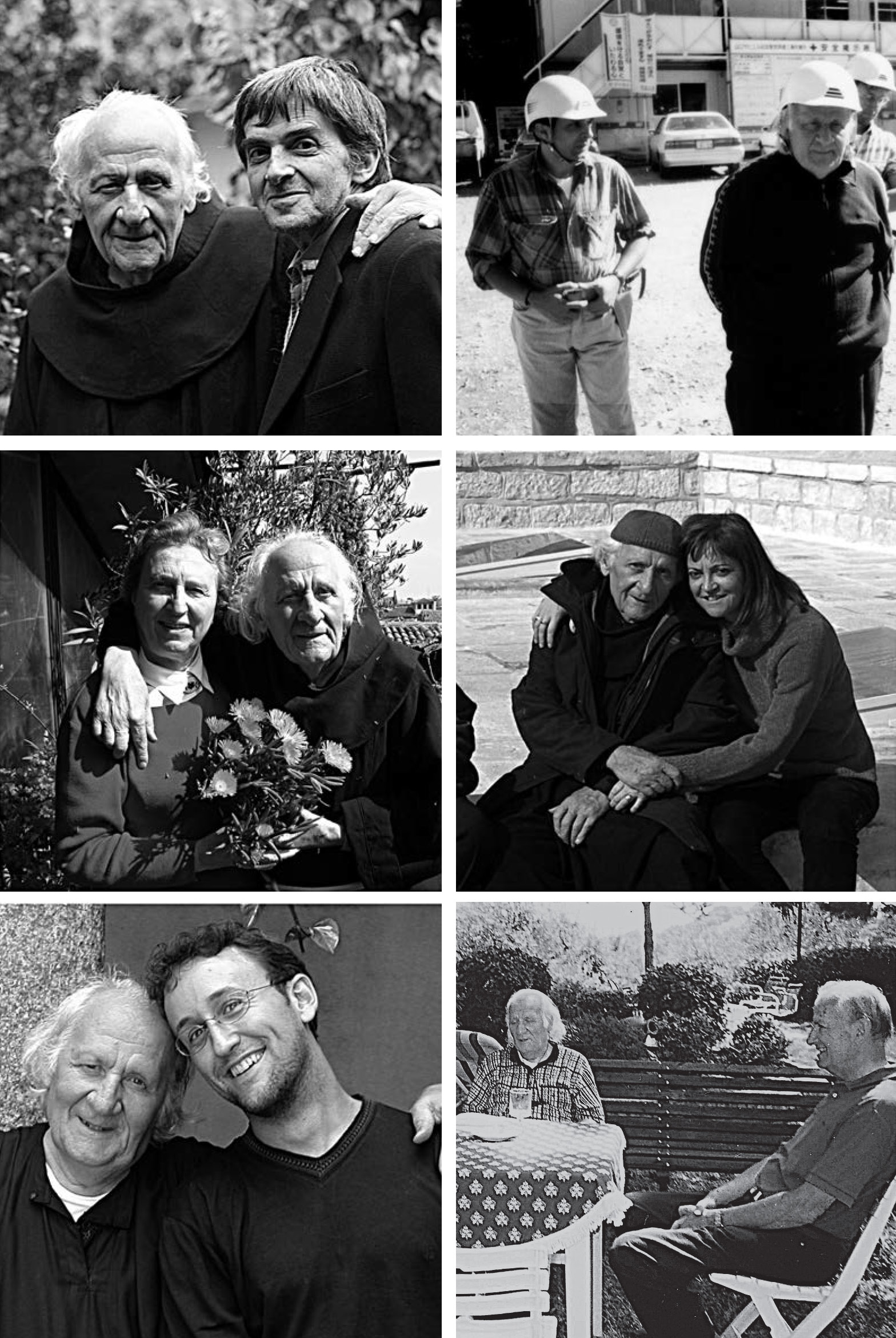
His father, along with his architect friend and studio collaborators: Luigi Leoni; Massimo Ravazzano; Carmen Romagnano; Chiara Rovati; Andrea Vaccari; Ignazio Breccia Fratadocchi
He had friends Lina and Giordano Ercolessi, who, having met through Father Nazareno Fabbretti and Father Davide Maria Turoldo, owned a beautiful fountain pen shop next to the Milan Cathedral. Desiring a peaceful retreat, they asked their father to design their home among the olive groves of Tuscany. In Barolo, in the Vergne area, among the Langhe vineyards, Milena and Aldo Vaira asked him to create stained glass windows for their cellar; they became so fond of him that they later entrusted him with the project for the expansion of their farm. In Turin, he cherished his friendship with Ernesto Olivero, who called upon him to design the chapel in the Sermig, the Arsenal of Peace, which he transformed from a weapons forge into a place of welcome open to all. Don Lorenzo Tous expressed his admiring devotion by inviting him to design the winter chapel of the cathedral of Palma de Mallorca and, later, a church in C’an Picafort, on the same island. In Pavia, the artist-friar also experienced intense moments of inner reflection. On a wall of his studio above the church choir, in the 1990s, he wrote this phrase: “beata solitudo.” He experienced moments of intense reflection in his artist’s studio, which, over time, he expanded with other spaces: the cellar, where the antique blown glass sheets were stored; the fifteenth-century rooms on the first floor, where his artistic work took place; and even higher up, in the convent’s former granary, his personal studio, which extended into the attics. He was involved in projects at sanctuaries, convents, and monasteries, such as the Carmelite Desert of Varazze, the Poor Clares Monastery in Chiavari, the Sanctuary of La Verna, the Carmelite Monastery in La Spezia, the Franciscan Convent of San Romolo in Figline Valdarno, and the Franciscan Convent of Brunella in Varese. In many Italian parishes, we were called upon to erect more than thirty new churches and carry out numerous furnishings and liturgical renovations to presbyteries.
For him, every situation was an opportunity for fraternal testimony, for powerful messages that were inextricably linked to his professional experience, which was indeed enriching, thanks to the fascinating input he managed to stimulate during the design and construction phases of his projects. The exchange—of assessments, visions, and perspectives—was uninterrupted, even during convivial moments, always filled with friendly and knowledgeable conversations. When he addressed a topic dear to him, thanks in part to his warm and convincing voice, everyone was attentive. It was a blessing to share these human and professional experiences. In a prodigious and unexpected way, over time, the possibility of travel to every continent emerged, marked by ever-changing encounters and an endless succession of opportunities, events, and adventures for the construction of new churches and stained-glass window series. The surprising climate in which we experienced them deserves to be briefly recalled here for a few occasions: in Rome, Africa, Japan, and the Holy Land. What happened after he was invited to give a lecture on Beato Angelico in Rome, with which he enchanted his audience, was a miracle. Among those present, he convinced Don Gianfranco Mori, priest of the Roman parish of San Bernardo di Chiaravalle, who entrusted him with the task of building a new parish complex in the Centocelle neighborhood. Once construction was completed and its consecration, the church was visited by Saint John Paul II, who, upon meeting his father, commented: “In the Middle Ages, man built great cathedrals to reach heaven; contemporary churches speak of a God who came down to earth.” Rome soon reserved an even greater surprise for us. In the Sacred Art Commission of the Vicariate of Rome that had approved the project for Centocelle, one of its members, engineer Ignazio Breccia Fratadocchi, recognized its beauty. It was he who urged Father Pasquale Silla, rector of the Sanctuary of Divine Love on the Ardeatina, to call Father Costantino for the construction of a new sanctuary. Father Pasquale accepted the advice. It was the Marian year of 1987, and more than forty years had passed since, in 1945, the citizens of Rome had made a vow to the Madonna to build a great new sanctuary for the salvation of Rome. Abandoning the monumental ideas of previous designers, the father envisioned a country house for the Madonna, in the valley outside the walls, surrounded by the soft rolling hills. There he saw the new sanctuary, which we immediately set about modeling in plasticine. Sister Rosaria, who served in the pilgrim’s house, where we were staying when I was drawing on tracing paper, told me one morning that Don Umberto TErenzi, the founding priest of her congregation, had confirmed to her in a dream the appropriateness of the choice of location. In reality, the area identified, being Roman countryside, was not buildable according to the current urban development plan; therefore, we felt we had undertaken an impracticable undertaking. However, once again, when her father was called to give a conference, together with Don Silla, at the Gregorian University, he was very convincing in outlining the project. He hit the nail on the head and achieved his goal when he said: “Outside the tower of the first miracle, towards the valley, I lift a clod of earth and underneath I create a blue grotto.” We had confirmation of this when, on November 2, 1987, we went to the councilor for urban planning of the City of Rome, who greeted us with the greeting: “Welcome! When I was a child, my grandmother took me to the sanctuary of Divine Love.” The homage to Mary in Father Costantino’s conference had struck him and mobilized the entire office, which, by morning, had found a solution to allow the realization of our project, despite the existing urban development plan. Municipal approval arrived by December 31 of that same year. The African experience was also intense for the people he met. The Friars Minor of the Liguria region had opened a new mission in Burundi in 1970. In Kayongozi, two hundred kilometers from the capital, Bujumbura, they had just built a convent that lacked a church. In 1979, they asked Father Costantino if he would be willing to undertake a trip to evaluate its implementation. Father Costantino’s health was not very good, but he accepted the invitation. In the diocese of Ruyigi, he met Bishop Ruhuna, who invited him to travel throughout the diocese to obtain advice useful for his ministry. I too met him when he came to Kayongozi for a pastoral visit, and I appreciated his kindness and evangelical courage. He would soon be a heroic witness to this, becoming a martyr in tribal warfare. The encounter with Japan was unforgettable, where we retraced the epic of evangelization that, like a mighty wind, the first companions of Saint Ignatius of Loyola had experienced in the 16th century.
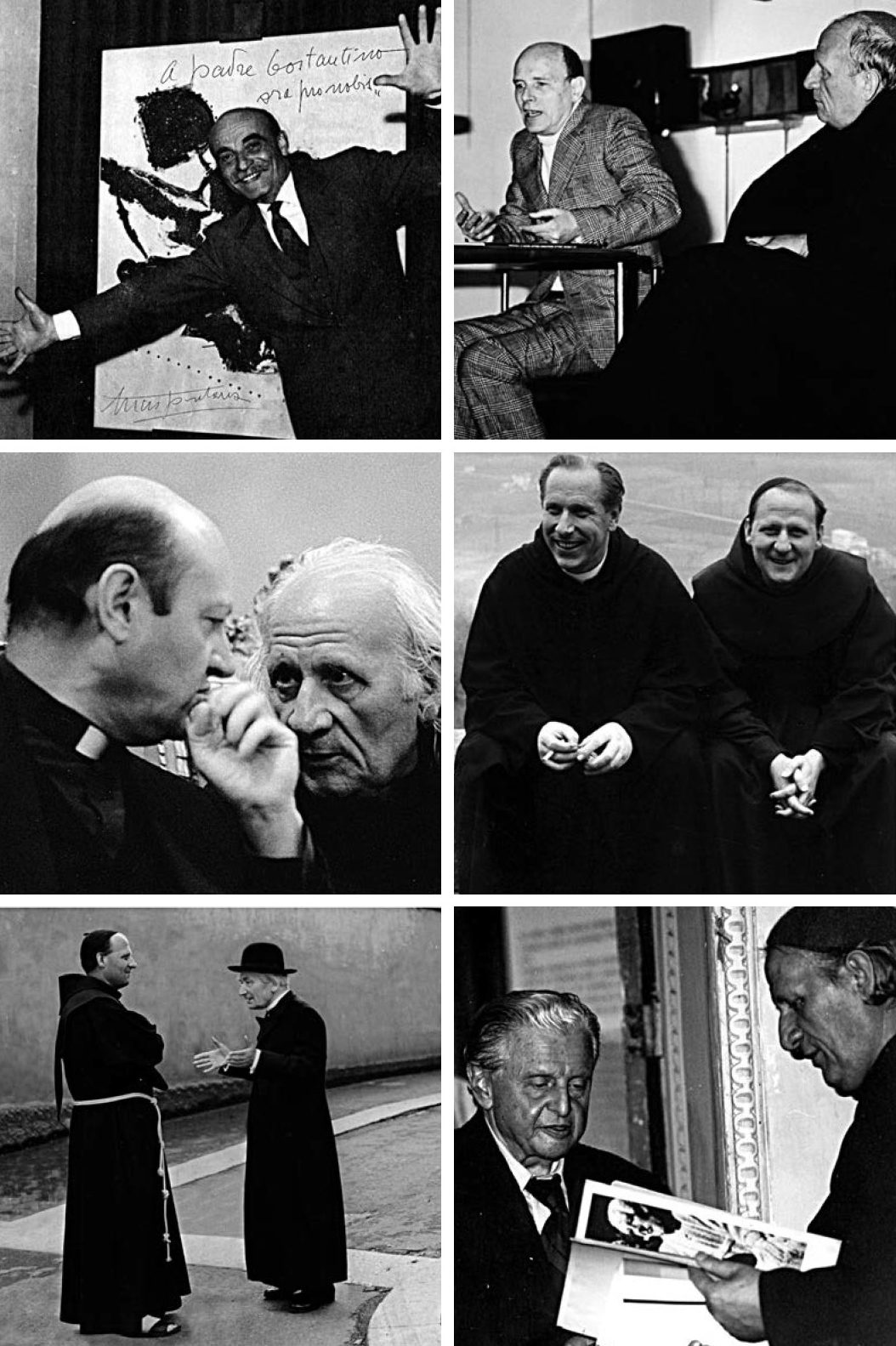
The father with friends from the worlds of art and the church: Lucio Fontana; Guido Ballo; Gianfranco Ravasi; Davide Maria Turoldo; Cesare Angelini; Luigi Figini
In Yamaguchi, a city in the southern part of the large island of Honshu, a megalopolis famous for being the birthplace of eminent figures in national politics and culture, Saint Francis Xavier had laid the foundations of a Christian community, with the zeal of Saint Paul in the first decades of Christ. Five hundred years after the Jesuit evangelization, we found here the most flourishing Catholic community in the entire Japanese nation. For a long time, a sanctuary with two towers had stood atop the hill overlooking the city, like beacons of light announcing the risen Christ. A great fire in the early 1990s had destroyed the entire wooden structure. The superior of the Yamaguchi convent, now deprived of its church, was the Jesuit missionary Father Domenico Vitali. Having come to Milan to ask the brothers of the San Fedele Cultural Center for suitable designers, he was advised to meet with Friar Costantino, their friend and an excellent artist and architect. The final gift for us was the opportunity to work in the Holy Land, the land where Saint Francis, during the Crusades, met Saladin. We happened to be immersed in the drama of a land constantly contested by peoples, witnessing warfare during the Intifada. In the Custody of the Holy Land, we met the sons of Saint Francis, called from all over the world to be representatives of every Christian people, a great family that has kept the Christian faith alive there for eight centuries.
In Bethlehem, we were guests of a conventual community of young friars preparing for the priesthood. In the refectory, we could see their faces, joyful and open to hope, alongside those of the older, more experienced friars: they gave us an air of purity and love in a world torn by hatred and conflict. Then, at the beginning of the second millennium, Father Costantino rejoiced with us, but, growing older, he was also beginning to complain of fatigue from his travels. With Chiara Rovati, an architect like me, I conducted numerous site inspections here, necessary for the construction of a new chapel dedicated to the Mother of God and for the restoration of the Grotto of Our Lady of the Lactating Nursing Home, which we inaugurated with the custodian of the Holy Land, Father Pierbattista Pizzaballa. Relations with the fathers of the convent of San Salvatore and the Flagellation of Jerusalem, at the Studium Biblicum, had also intensified. At the Via Dolorosa, we often met with Father Michele Piccirillo, the renowned archaeologist friar who entrusted us with various projects in Israel, Jordan, and Syria, which we discussed with Father Costantino.
Finally, I recall that, while he had already undertaken important trips in his youth to experience firsthand contemporary works of art and architecture, one of which included a personal encounter with Le Corbusier, in Pavia, thanks to the establishment of the Frate Sole International Prize, he managed to bring the most celebrated architects of Christian churches, such as Tadao Ando, Alvaro Siza, and Richard Meier. In bidding farewell to Father Costantino, for whom I composed a text on June 25, 2007, commemorating the journey we shared, it was clear to me that it had been traced by the Holy Spirit, in a crescendo of prodigious stages.
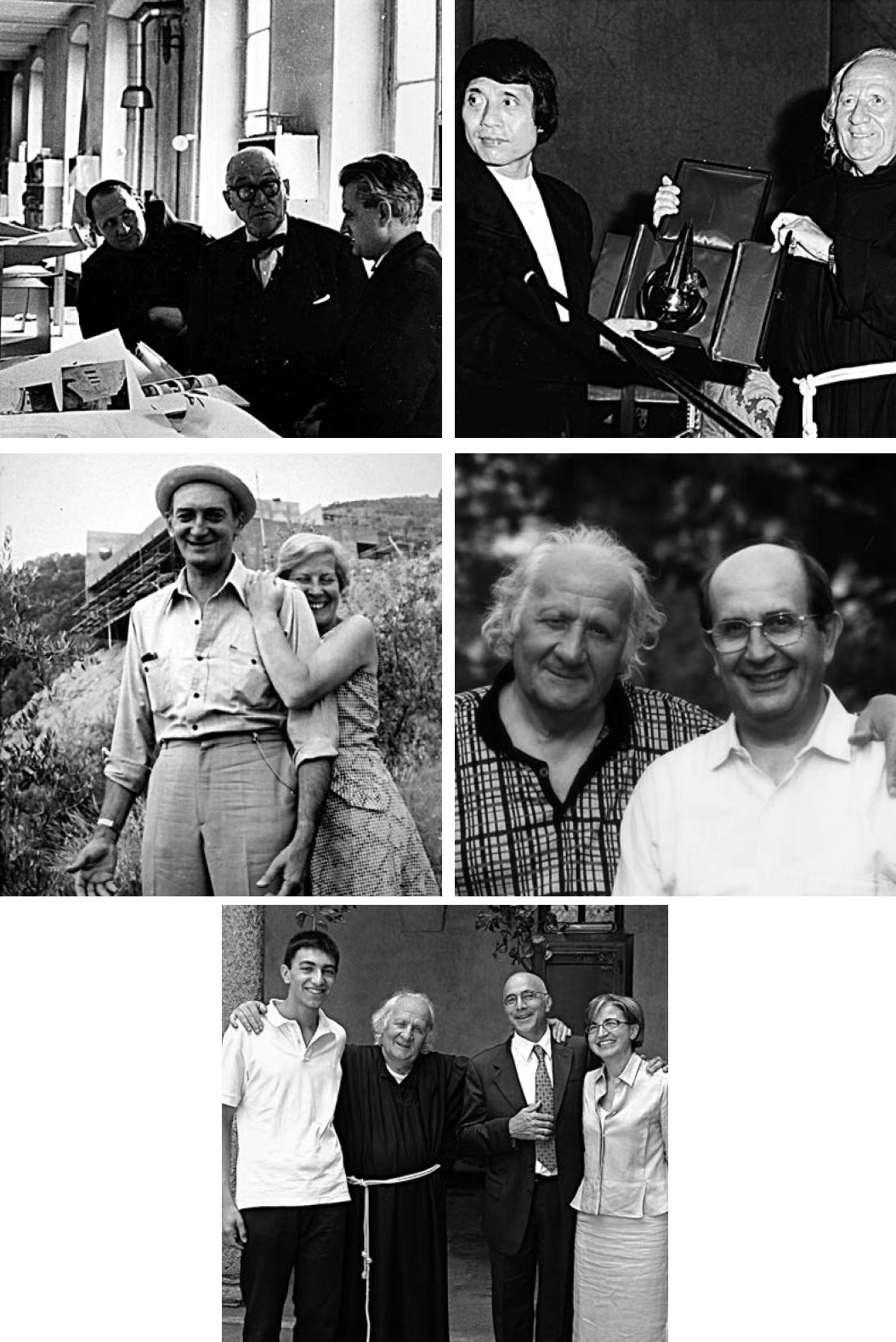
His father, with architects and friends-clients:
Le Corbusier; Tadao Ando; Vittorio Moretti; the Vaira family; the Ercolessis; Ernesto Olivero