

“Forgive me if I didn’t put a halo on you”1
Virtus Zallot
A Franciscan painter
“Having been no less an excellent painter and miniaturist than an excellent religious man, he deserves, for both reasons, that he be honored in his memory.”2 Giorgio Vasari’s introduction to the Life of Beato Angelico aptly describes Costantino Ruggeri: an excellent religious man and an excellent artist, a Franciscan painter and a Franciscan painter. “From the beginning,” Ruggeri recalled, “I wanted to be a friar, the parish priest of my town, and my uncle, the priest, wanted me to become a priest, but I didn’t. I want to become a friar.”3
With equal determination, he became a painter, starting with the drawings that decorated greeting cards for his superiors, copying famous works of the past, capturing in his eyes and heart the frescoed images in the churches of his native Adro, and discovering, while still in high school, contemporary art in “Il Frontespizio,”4 which “was truly a modern magazine.”5 Religious and artistic vocations grew together, and throughout his life, Ruggeri practiced art as a manual labor that, in the Unstamped Rule, Francis prescribed to his brothers, granting them “the necessary tools and instruments”6 to practice “that craft they already know.”7 Art, for Ruggeri, “besides being a feast for the eyes and a light for the spirit, becomes a revelation of the divine in the world, a poetic presence, a revelation of the secrets of the earth and a prophecy of those of heaven.”8 Not, therefore, a didactic and informative tool that teaches, describes, or narrates, but a device that acts, a “form that reveals. It does not ‘aim’ at anything, but ‘signifies’; it does not ‘want’ anything but ‘is’”9; a place in which to “become silent, to gather oneself, to enter, to look with awake eyes and an open soul, to spy, to relive.”10 The priests themselves should have courageously welcomed it by rediscovering, as Paul VI hoped, the centuries-old friendship with artists and renouncing “the substitutes, the oleograph, the work of art of little value and little expense”11. Friar, priest and artist, Ruggeri placed himself at the disposal of the Church in many churches, sometimes welcomed with suspicion and in some cases with hostility, but remaining happy: because perfect joy does not come from successes of which “we cannot boast, because they are not ours, but God’s”12, but “is to conquer oneself and willingly endure pain, insults, opprobrium and discomfort for the love of Christ”13. In the memory of those who knew him, Ruggeri also adhered to the following exhortation of Francis: “And let the friars beware of appearing sad on the outside and dark in face like hypocrites, but let them show themselves happy in the Lord and joyful and politely cheerful”14. However, if his public art joyfully sings of God and the beauty of creation, his private art (an almost daily exercise practiced in his cell-atelier) also recorded the “pains, injuries, opprobriums and discomforts” of man, and of men.
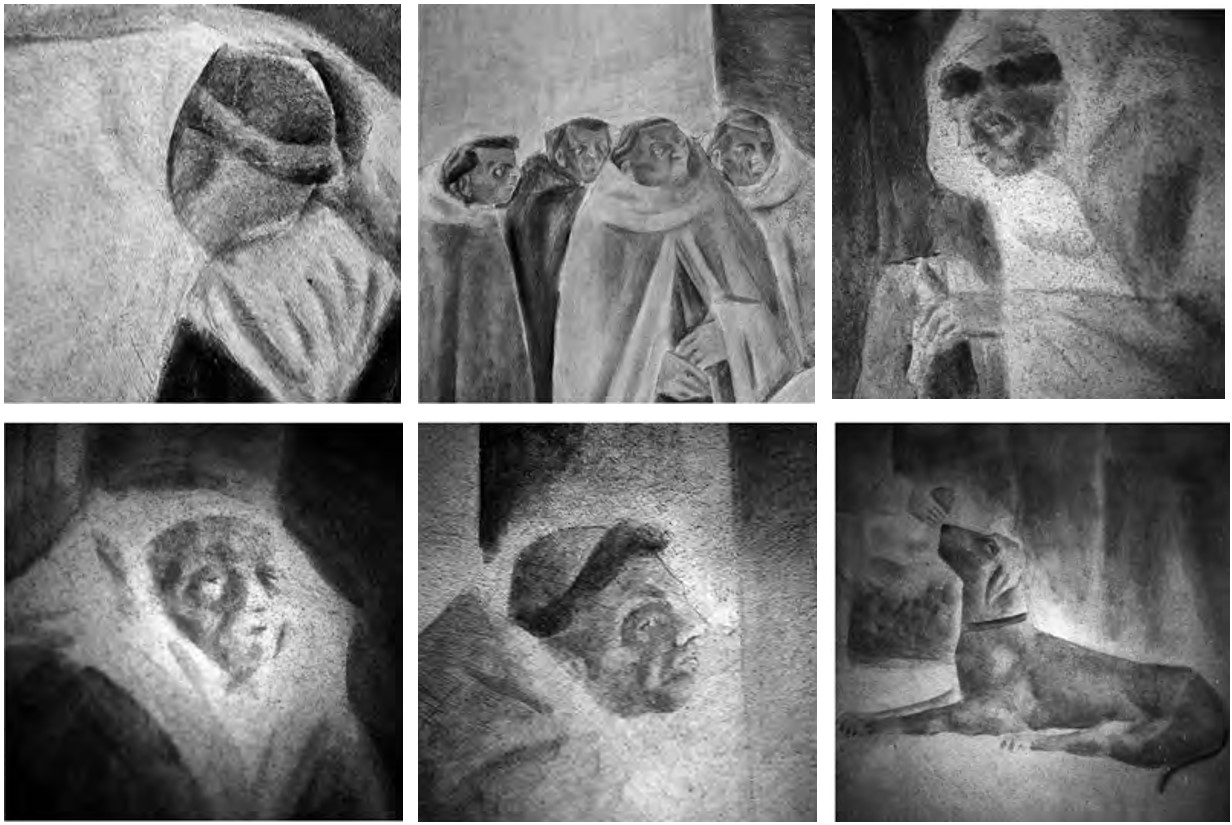
Stories of Saint Francis, 1949, fresco, details. Busto Arsizio (Varese), Convent of the Friars Minor
Since his inner self was “always modeled on the face of Francis,”15 his life and art were entirely Franciscan. Membership in the Order was not an obstacle but “on the contrary: a great help. For an artist, it is the ideal condition. I have seen artists who have been ruined by a life that was too worldly.”16 The joyful poverty of the Friars Minor guaranteed him freedom. Not craving success, he remained independent of public tastes and the mechanisms of the market, declaring himself “ready to give up everything rather than sell out and surrender to fashion.”17 He added: “The question of other people’s judgment has never bothered or worried me. I walk as best I can, and I also try to fly.”18 He also reiterated, “I have never regretted having to give up some important assignment so as not to betray beauty.”19 Poverty and freedom, however, were a means and not an end. Poverty, as Raoul Manselli observed with regard to Saint Francis, was a condition that “brings to completion the choice of availability to others, of love for others.”20 Ruggeri, in fact, donated his work or donated the proceeds, for example by selling works to help finance projects that the priest-patron struggled to support. Freedom was a premise and a promise to him, since “the Franciscans above all, starting with Francis himself, are par excellence the testimony in the world of the freedom of the spirit that becomes love.”21 A love that he embodied in his works. Ruggeri, finally, was a Franciscan in humility and sobriety. Humility being “the only measure that guarantees a sense of reality, of oneself.”22 Sobriety also as an artistic practice. He deplored the superfluous, pleasantry, and mannerisms. Sometimes making a virtue of necessity, he used humble tools, colors, and supports, even recycled ones, yet he saw this condition as an opportunity, not a limitation, since the humblest tools “can also be transformed into instruments of poetry and song.”23 He loved his “hard, frayed brushes”24 and recalled: “I never threw them in the garbage. I either burned them or buried them”25 because “I feel the brush as an extension of my body […] it’s not a piece of wood with bristles, it’s an expression, an extension of the strength of my hand and my heart. So, how can I throw them away?”26.
In his laboratory-cells, Ruggeri worked free from the needs and commitments of the world, but not isolated from it, but rather living it disinterestedly: perhaps, inevitably, reducing his field of experience while preserving its authenticity. He intensely experienced contemporary art, frequenting colleagues and critics, visiting exhibitions, exhibiting, reading, and traveling (starting with his youthful artistic escapes). He equally intensely (and humbly) engaged with tradition, which he nevertheless considered not a past to be revered and imitated but rather “a serene furrow, which, however, must be incessantly opened forward, without ever expecting to be understood. He who advances freely, regardless of whether tolerated, is faithful to tradition.”27 After the jumble of experiences of his youth, from 1959 Ruggeri found in tranquil Pavia the physical, existential, and spiritual place to work in serenity because, “whoever practiced this art needed quiet and to live without worries, and […] whoever does things of Christ must always be with Christ.”28 From his Franciscan nest, he explored the horizon like a periscope that sees without being seen, undisturbed and undisturbed by the context.
His laboratory cell recalls the hill to which the first Franciscans led Lady Poverty, to show her “all around the land as far as the eye could see, saying: ‘This, lady, is our cloister’”29.
Franciscan Stories
“When he began painting, still a student,” Nazareno Fabbretti recalled, “the friars tore their hair out. Seeing those black and hard Saint Francises […]. They, the good masters, were accustomed to a different sacred and Franciscan art, dotted with rosy stigmata, blond beards, turtledoves, and white clouds against cobalt skies.”30 The source of the scandal was the young Ruggeri, a theology student at the Convent of the Sacred Heart in Busto Arsizio, where, in 1949, he had frescoed a Franciscan cycle.
An aspiring artist, in 1948 he was paired with Vittorio Pandolfi, who was busy painting four Franciscan episodes in the presbytery of the adjacent church. Once the work was completed, Pandolfi gave him brushes and paints, inviting him to continue on his own. The passing of the baton was certainly only technical and operational, as demonstrated by the obvious conceptual and stylistic gap between the works of master and student, so spatially and temporally close: “Our points of view on art did not coincide at all,”31 recalled Ruggeri, who nevertheless held Pandolfi in gratitude and esteem.
Thanks in part to this precious gift, Ruggeri obtained permission from his superiors to fresco three scenes in a relatively marginal room on the first floor in the section reserved for students, and only if his academic performance would not suffer. The three episodes (Francis and his First Companions, Francis and the Miracle of the Water, and Francis and the Poor) demonstrate remarkable iconographic intelligence and a capacity for synthesis. Ruggeri was satisfied, as he transferred them without significant variations (but attenuating their chromatic and formal grace) into the larger Franciscan cycle he later created on the ground floor, in the convent’s main corridor. This intervention was subject to the approval of a sample scene. He introduced Francesco and his first companions. “I deliberately and meticulously paid attention to the anatomical details of the figures,” he recalled, “certain that a positive judgment would be determined, more than by formal values, by a certain ‘pleasant,’ traditional expression on the faces. So I did, and I hit the target.”32
Once granted permission to continue, he painted Francesco and the Miracle of the Water. “The figures and the landscape seemed barely sketched, as if it were a work left half-finished. But for me, that’s how it had to be,”33 he recounted. He then reassured the perplexed friars, stating that “to have an overall vision without second thoughts, I needed to sketch everything out, and then I would finish the work properly.”34 Thus, “having completed the so-called draft of all the episodes, one fine morning I destroyed the ‘examination paper,’ the master fresco, and quickly redid it in the style of all the others.”35
“They are truly beautiful and modern,”36 declared a small friendly commission called to inspect the paintings; Pandolfi responded to the friars’ complaints by stating: “The fresco must remain as authentic as it is. Embellishing it with additions would ruin everything […]. If there are errors, let them remain! The important thing, dear friars, is that there is imagination and poetry here.”37
In selecting and designing the scenes for his cycle, Ruggeri avoided edifying and sugarcoated expositions. He did not lay out a plausible and detailed reconstruction of ancient events, but images to be meditated upon in order to act in the present. Avoiding the marvelous and the extraordinary (for example, the impression of the stigmata, the visions and the prodigies are missing), he wanted to “narrate not so much the miracles of Francis, which demonstrate sanctity but do not constitute sanctity, but rather the mirror of his exemplary life”38. The celebrations of the seventh centenary of the saint’s birth and the publication, in the same year 1882, of the encyclical Auspicato Concessum had initiated a season of new investigations into Francis, intended to purify his biography of legendary aspects. Subjected to this revision, his sanctity consolidated rather than weakened. “The embellishments added to his life have made us forget the true and real Saint Francis, who is so much more beautiful,”39 wrote Paul Sabatier in 1894, adding that the saints who emerge “from the golden depths of triptychs, and not from the dark depths of reality […] perhaps earn a little more respect among superstitious people, but their lives lose something of their virtue and communicative power. Forgetting that they were men like us, we no longer hear their voice in our conscience crying: ‘Go and do likewise.'”40
A hundred years later, Jacques Le Goff would reiterate: “This human man, very human, is nevertheless a saint, a true saint of the thirteenth century, sufficiently exemplary, exceptional, and totally Christian to still be a saint of today.”41
Ruggeri also proposed a Francis whose sanctity is more experiential than miraculous. He declared that he was inspired by I Fioretti (“but – he added – in reference to the life of contemporary man”42), the least attentive biography
Deceptively simple, yet capable of conveying the freshness and novelty of the message and sentiment of the early Franciscans. Adapting his pictorial style to that of narrative, he created an almost naive style of painting, a kind of visual poetry that “instead of exposing facts […] makes a direct appeal to the imagination, communicating emotions, feelings, and atmospheres,”43 succeeding where much contemporary, more realistic and descriptive Franciscan painting failed.
“There is no pictorial malice; they are innocent, candid, they are Franciscan! These are dreamed, ideal visions; I wanted to make them ethereal, like dreams carried by rays of light,”44 he declared. The spontaneity of I Fioretti is conveyed by a kind of lightness; the simple figures are imbued or surrounded by luminous whites that make them almost evanescent; the gestures are slow, the places abstract, the atmosphere silent. However, the small heads, which emerge from the broad, monumental bodies, lack any “traditional, pleasant expression.”45
Francis, too, is ugly, as Masseo had mercilessly declared: “You are not a beautiful man in body.”46 Yet, he was “enchanting, stunning, and glorious in his innocence, in the simplicity of his words, in the purity of his heart, in the love of God, in his fraternal charity, in the promptness of his obedience, in his courtesy, in his angelic appearance!”47
Likewise, the Franciscans, ugly but beautiful for the goodness of their gestures and actions, a beauty that is love. Finally, the needy are even deformed: precisely because of this condition, which visualizes pain and poverty, they cry out for love because, as Francis recalled, “our master Jesus Christ […] says that the healthy do not need a doctor, but the sick do.”48
The first three episodes of the cycle (Francis and his companions, Francis and the miracle of the water, and the approval of the Rule) introduce the foundations of Franciscan life: fraternity, the Gospel, and belonging to the Church.
They are followed by a miracle, Francis helping the poor, Francis and the wolf of Gubbio, and an episode of difficult interpretation that, like the next, is partially obscured by a ladder. This second thematic block reminds the brothers of their necessary commitment to the world. Finally, in the Ascertainment of the Stigmata, the saint’s body reveals its adherence to the Crucifix, in comparison with Christ in the large Crucifixion at the top, at the end of the corridor and the figurative narrative. In contrast, the Death of Francis and Francis and the Worker form an autonomous diptych, removed from the narrative, exhorting us to gather Francis’s testament and renew it in the present.
The initial episode (Francis and his companions, but significantly called Francis and his friends by Ruggeri) unfolds in two scenes: in the first, the saint welcomes a (new) brother with an embrace; in the second, his small, primitive community is depicted. Francis’s embrace is a prototype and figure of brotherhood. Of his first companions, Thomas of Celano recounts: “Every time they met somewhere or on the street, as could happen, it was a true explosion of their spiritual affection […] And they were chaste embraces.” 50 Of the trial version, Ruggeri recalled: “a cluster of young friars surrounded Francis, all radiating happiness and brotherhood.”51 The final version, however, shows them decidedly worried and sad, almost as if sensing the difficulty of the mission that awaits them.
The Miracle of the Water, also known as The Source of the Gospel, follows. The scene is inspired by the iconography of the episode in which a poor man quenches his thirst at the spring that, through the intercession of Francis, miraculously flows from the rock. With arms outstretched, against a shadowless backlight, it is the saint who is leaning toward a source—not of water, but of light. His gesture, the same one with which in iconographic tradition one prepares to receive the stigmata, expresses a sort of surrender, declaring his utmost availability.
“And after the Lord gave me friars, no one showed me what I should do; but the Most High himself revealed to me that I must live according to the form of the Holy Gospel,”52 recalled the saint, who, “rapt out of himself and transported into a great light, which expanded the space of his mind, was able to freely contemplate the future.”53 Ruggeri visualizes this revelation as a source of water/light: water “welling up to eternal life”54 and “true light, which illuminates every man.”55
The subsequent Approval of the Rule shows the saint and his companions kneeling before the pope. Ruggeri replaces the traditional scroll with the incipit of the Rule with a bunch of roses that the pontiff receives (or offers), a symbol of “Franciscan spirituality given, welcomed, and returned.”56 Lacking elements that allow for its historical placement,57 the scene is an image of the Order placing itself at the service of the Church.
The following illustration is sometimes interpreted as a miracle.58 The lack of wonder
(Francis’s companions even turn their backs on him) seems to suggest a “banal” work of mercy, with the saint helping a poor family. The episode introduces the thematic block dedicated to Francis’s charity.
In the next scene, he offers an offering to some poor people with monstrous faces (even more so the women). Equally ugly and sad, the Franciscans seem to anticipate Pope Francis’s invitation to become “sick with the sick, afflicted with the afflicted.”59
Francis and the Wolf also avoids the conventional display of the miracle that would have the inhabitants of Gubbio express gratitude and amazement with dramatic gestures. The similar scene by Pandolfi, in the adjacent convent church, shows alongside the saint a woman spinning, a farmer, and a placid sheep, which the awkward modernization and contextualization (in a serene rural landscape) render obsolete. Ruggeri’s scene, however, remains untouched. Around Francis, the Franciscans of the past (in the paintings) are the same as those of today, both witnessing a small miracle of forgiveness and acceptance that everyone can emulate, in the knowledge that wickedness is sometimes induced by circumstances and desperation: “For I know well,” Francis said to the wolf, “that it is because of hunger that you have done all kinds of evil.”60 The core of the next episode is a group of figures stripping (or dressing) under the watchful eye of a small group of friars and lay people. The Franciscan in the foreground, prostrate on the ground, may represent the brother guardian sent by Francis to the three thieves to ask forgiveness for having unfairly chased them away; the saint, in fact, advocated a charity without prejudice. The stripping would, in this case, refer to the subsequent conversion of the criminals who, repentant, prepare to assume the Franciscan habit.61
The Ascertainment of the Stigmata follows. Thomas of Celano narrates that, when his grief-stricken companions discovered them on Francis’s body, “mourning turned into song and weeping into jubilation.”62 Ruggeri, however, presents the sad vigil around a deceased friend: rather than the recognition of an extraordinary event, therefore, “the perennial drama of the loss of loved ones.”63 A similar conception presides over the Crucifixion, an image of the pain of those who remain: pain that is imprinted in the figures and the landscape, in the fragmentation of the forms, in the tight rhythm of the composition, and in the rich, muted colors. At the feet of the crucified Christ without a cross, a pile of bodies piles up as if exploded. The thieves and mourners are dramatically deformed; Mary has a horrid grimace stained by tears, and John’s small head does not appear human. Some friars observe and meditate; spectators of the sacred drama, they suffer the comassion together with the brothers (who pause before the work).
The same shared feeling pervades The Death of Francis, depicted with Francis and the Worker at the other end of the corridor. Around the saint’s body is a vast repertoire of gestures of grief, contained within the solid and synthetic masses of his clothing, echoing Giotto and fourteenth-century lamentations. Some poor people advance from the right and, below, dramatically shatter. Contemporary art offered interpretations of this episode dominated by a certain sentimentality. Ruggeri offers a dry and rough version, in which simple, elementary figures raise a chorus of love. The spectacular blue robe, tinged with the sky, places Francis in paradise without the use of clouds, lights, or angels.
Francis and the Worker, finally, is a sort of visual testament that anticipates the words of Pope Francis: “Open your hearts and embrace the lepers of our time.”64 Ruggeri replaces the leper, the quintessential medieval outcast, with a worker exposed to the dangers of labor and lacking social safety nets; the neutral setting of the previous episodes is replaced by the urban-industrial setting of a society just emerging from war.
Composing a sort of triptych, in the central scene he depicts a poor, naked man, supported and protected by a small group of friars surrounding him while others look on; on the left, Francis (or a Franciscan) carrying an injured worker on his shoulders; on the right, Francis (or a Franciscan) offering food to a small group of poor people preceded by a supplicant or grateful woman. A man, armed with a rifle, smiles. It is perhaps the only smile in the entire cycle: a smile of hope.
His Saint Francis
Saint Francis,65 exhibited in 1951, in Ruggeri’s first solo exhibition at the Galleria San Fedele in Milan, is a solid, immobile, faceless figure that seems to illustrate the following words: “We have no need of that face of yours. Because everyone can have your face in some way, and you can have, now as then, everyone’s face.”66
Ruggeri, in fact, filled that void both with the essential features of each man (everyone’s face) and with the portrait of specific men (because everyone can have your face in some way): always, however, eschewing stereotypical and pleasing physiognomies, pathetic expressions, and artificial postures.
Even when he illustrated Francis and the Birds, he avoided “reducing Saint Francis of Assisi to a romantic saint, to a lover of nature who speaks to flowers, birds, fire, and clouds, as children and poets do.”67
In the one painted in 1959 on the façade of the Franciscan church near the Tonale Pass,68 he revived Giotto’s profile arrangement. In contrast to the solid and concrete construction of the model, he nevertheless traced a delicate, almost evanescent figure, with a childlike sincerity and simplicity. The episode depicted (among many depicting Francis with birds) is likely the arrival on Verna, as the saint extends his small head and hands toward the birds that come to meet him: “I believe,” he said to his companions, “that our Lord Jesus Christ is pleased that we live on this solitary mountain, because our sisters and brothers the birds show such joy at our coming.”69
Uccelli, published in 1980 in Francesco e gli amici,70 seems to refer to the same event. The delicate and rarefied figures of the Tonale scene are replaced by the intricate comings and goings of a multitude of birds in flight; A dense, nervous crisscross of lines runs through simple, essential contours; a joyful frenzy flows through silence. Like a lively snapshot, the work seems to illustrate the countryside adventure of an ordinary little friar who, joyfully assailed by a flock of birds, laughs and looks at us.
Perfetta letizia, tempera on masonite created in 1980,71 is instead an incandescent vision extrapolated from time and space. Imparted with broad, synthetic brushstrokes, Francis and the birds seem applied to a non-earthly sky that two circles (one yellow and one green: the sun and the earth?) render immobile and abstract. The shift in expressive register corresponds to the image’s different meaning: not a story but a probable figure of the Order, in which the dove-birds represent the Franciscans.72 Even in the depiction of Francis, as in every aspect of his artistic work, Ruggeri sought and experimented with different forms, languages, and techniques. In the panel for the church of Santa Maria all’Ospedale San Carlo Borromeo in Milan,73 he assigned him the traditional iconographic attributes denoting his sanctity. These indicators (requested by the patron) characterize all his hospitaller saints as a necessary condition for their distinction and recognizability. As in a medieval altarpiece, the hieratic Francis is equipped with a halo, cross, book, knotted cord, and, above all, stigmata. Not drawn but carved with iron heads, they seem to recall “not the holes of the nails, but the nails themselves, formed of flesh the color of iron”74 described by Tommaso da Celano.
A Saint Francis by Ruggeri was the cover image of the 1982 Franciscan Calendar,75 after being published in Francesco e gli amici (1980) and in Quivi perfettaamicizia. Francesco e i suoi (1981).76 In contrast to the synthetic and indeterminate physiognomies of the examples cited so far, this face in the foreground has a detailed physicality, so much so that it has been defined as “A true portrait of St. Francis”77. It is, in fact, the image of a real man78 who gazes at us intensely, his head slightly inclined, his hair disheveled, a few wrinkles on his forehead and a slightly pouty mouth. Transcending historical distance, biographical elaborations and iconographic tradition, he appears alive before us. Nothing indicates his sanctity. “Forgive me if I did not put the halo on you, of which your friends the pope and cardinals were immediately generous and jealous,” Ruggeri apologized. “In that way I would have only consigned you to the past, you who experienced all feelings and things anew”79; And he added: “In giving you a face that was right for you today, I did not obey internal patterns and memories, however profound and precious. I left all the past behind me, to look at you, accompany you, question you like a man of my time.”80
The friends of St. Francis
Already addressed in the Busto Arsizio series, in the early 1980s the theme of Francis and his friends took on a new structure and character. Extracted from the story and depicted individually, Francis’s companions became the protagonists of the aforementioned publications published on the occasion of the celebrations for the eighth centenary of the saint’s birth: Francis and his friends (1980), Here is perfect friendship. Francis and his friends (1981), and the Franciscan calendar Francis and his friends (1982). Eight plates by Ruggeri (plus two, Birds and Poverty on the cover) also illustrated Nazareno Fabbretti’s Francis and his friends (1981).
Francis and his friends from 1980 includes 24 plates compiled between 1950 and 1980, each commented by a short excerpt from Franciscan Sources. Here is Perfect Friendship presents 44 works dating from 1951 to 1980, accompanied by commentaries by Nazareno Fabbretti and quotations from Franciscan sources; this rich volume also features an introduction and closing canticle by David M. Turoldo. The Franciscan Calendar, in addition to the portrait of Francis on the cover, is illustrated by twelve Friends (one for each month) with captions, very brief quotations from Franciscan sources, and, at the end, a collection of brief biographies of Nazareno Fabbretti.
Each publication includes works created at different times (some repeated) whose chronology is difficult to reconstruct; the oldest,81 tempera on cardboard, are accompanied by the more numerous portraits created through pictorial integration of photographic reproductions. Gradually expanding, the repertoire of friends includes, in addition to Francis’s original community, others who were close to him and, in a reconstruction that reaches the present, exponents of the Order and interpreters of his legacy (up to Don Orione, Gandhi, and Mother Teresa of Calcutta). Specific identities are juxtaposed with generic figures (Beggar, Leper, Poverty, even Satan), while the prevalent close-ups are sometimes accompanied by wider shots with multiple figures and minimal settings (Pacifico, Silvestro, Uccelli, Ladroni, Ipoor, Itinerant Friars, Work).
The paratactic composition and stylistic heterogeneity shape an intimately Franciscan conception of friendship, strongly inclusive and free of expectations and prejudice: “And whoever comes,” prescribed the unstamped Rule, “friend or foe, thief or brigand, let him be welcomed with kindness.”82
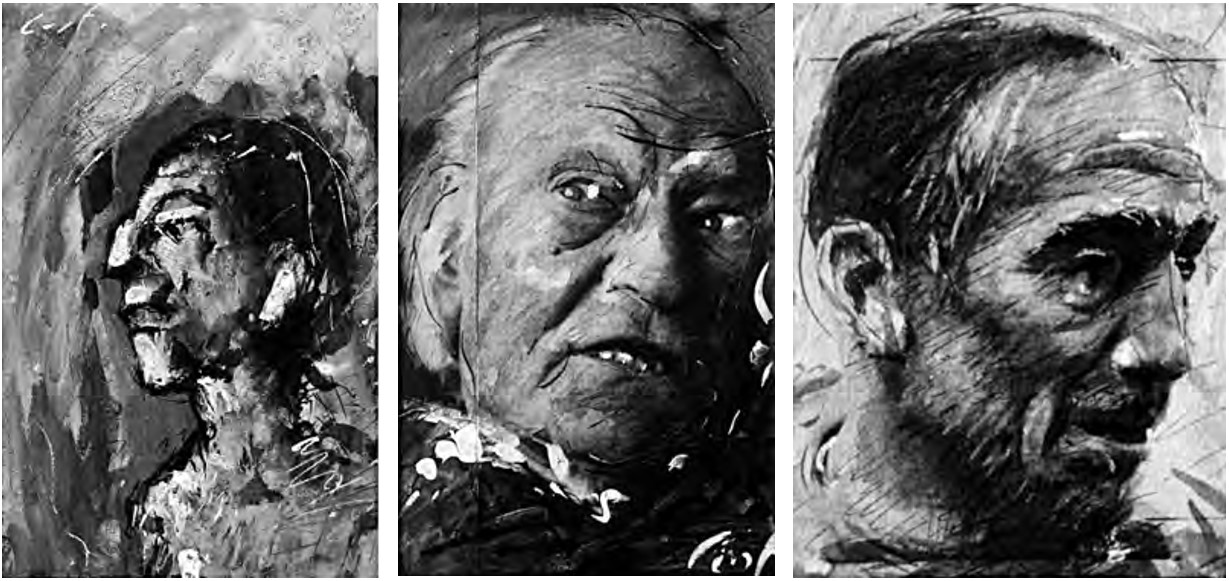
The Leper, Innocent III, Egidio, Pica, Chiara, Masseo, 1950-1980. From Ruggeri, Francis and Friends, Arti grafiche Barlocchi, Settimo Milanese 1980
They also testify to “Francis’s methodology of friendship. We mean the radical, almost fanatical, respect for the personality of each of his friends; the constant refusal to reduce those he loves, or who depend on him in any way, to a copy or even an imitation of himself.”83
In the typewritten text of a homily, Ruggeri addresses Francis with words that seem to clarify his iconographic method: “Close to you are your friends from then, but with the faces of your and our friends of today.”84
Modern and unwitting contemporaries lend their features to ancient figures, following a practice that finds illustrious precedents in the history of art. As a young novice, Ruggeri had already illustrated I Fioretti “taking some of my companions as models, especially for the faces”;85 and if in Busto Arsizio he had avoided any characterization to make the ancient Franciscans a mirror of every Franciscan, here he decisively distinguishes them to give them a concrete humanity. The procedure is similar to that adopted by Pierpaolo Pasolini in The Gospel According to Matthew (1964), whose protagonists were non-professional actors and the extras the local population. Eschewing conventional beauty and the caricature of ugliness, reconstructed poverty and slavish reenactment, Ruggeri, like Pasolini, created a humanity that was authentic because it was true.
Some of the friends, like some of the characters in The Gospel According to Matthew, were well-known faces. This device also finds confirmation in artistic tradition.86 Beyond the celebratory or defamatory purpose, the citation of a well-known person contributed to the recognizability of figures (real or abstract) that were otherwise physically indeterminate; for this to happen, however, it was necessary to establish assonances between the interpreter and the interpretation. Ruggeri, however, not only did not seek a correspondence in character, existential and physical terms, but at times contradicted it.
“Masseo’s attractive appearance and good sense, with his beautiful and devout speech”87 are not reflected in his portrait, with its squinting eyes and an expression more good-natured than witty.
Jacopa, the virtuous noblewoman whom Francesco wanted at his deathbed, is a clearly young and beautiful woman,88 even though the sources describe her femininity as mortified and austere.
Some solutions are surprising. The media power of the pop(ular) icon, masterfully highlighted by Andy Warhol, conveys the identity of perhaps more worthy (and overlooked) celebrities. Elia is played by Charles Aznavour, Lucchesio by Eduardo De Filippo, and Egidio by the coach of the Italian national football team, Enzo Bearzot. Giuseppe Ungaretti casts a grim look at the disturbing Innocent III, perhaps “astonished and frightened” after dreaming of the church of San Giovanni in Laterano supported by “a small, mean-looking priest.”89 Pacifico, “the most renowned of frivolous singers and himself a composer of worldly songs,”90 takes on the guise of Luigi Tenco. Ruggeri reworked a still from the singer’s intense performance at the 1967 Sanremo Festival. While specifically establishing a professional assonance between a contemporary and an ancient figure, it is nonetheless significant that he cast Pacifico as a man who had committed suicide.
The low angle and haughty bearing give the Leper an unexpected pride.91 The disturbing figure is perhaps the sick man, “so impatient, so unbearable, and so arrogant”92 whom Francis lovingly washed, healing him in both body and soul; however, he contradicts the conventional type of the needy, usually supplicant and emaciated.
Di Silvestro Ruggeri depicted repentance, preferring it to the “perfect life”93 that he, already elderly, chose to lead alongside Francis. The dramatic figure, surrounded by a heavy black shadow, has clenched hands and gazes heavenward while, taken aback by the saint’s generosity, exclaims: “I am truly a wretch! Here I am, old, and still insatiably lusting after and seeking the things of this world; while this young man despises and tramples them for the love of God.”94
The three thieves are not depicted as bold and dangerous bandits but as “humbly coming to beg, driven by grave necessity”95.
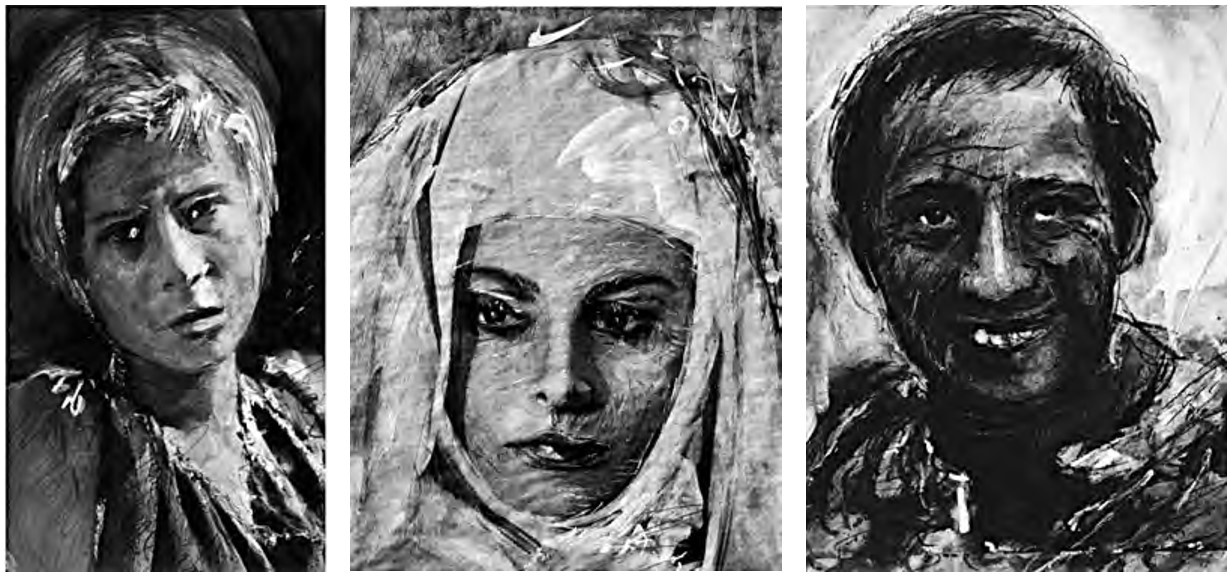
Simone, who prepared himself for ecstasy by lying in bed “because the tranquil sweetness of the Holy Spirit required in him not only rest of the soul, but also of the body,”96 is overwhelmed by irrepressible energy: posture and grimace are lent to him by an unbridled Dario Fo.
At times, in fact, Ruggeri activated a double translation of identities, having his friends played by actors playing a character. The dissonance between the role embodied in the reality of the stage fiction and in its iconographic transcription produces a sort of interpretative short circuit, which again prompts questioning.
Saint Clare is Sophia Loren in the role of the Nun of Monza. Ruggeri reworked the cover photograph of the weekly “Oggi,” which, in September 1961, had published an exclusive reportage of the screen tests the actress conducted with Luchino Visconti, in preparation for the filming of The Lady of Monza. In her face framed by the veil of the Humiliate Benedictines, Chiara displays a contemporary beauty, embodied in a media society by a sensual and famous actress; the evident moral gap between the great saint and the Manzonian nun is striking (and cannot be a coincidence).
A similar difference separates Orlando, who gave Francis the mountain of La Verna97, and Carlo Coriolano di Santafusca, the protagonist of The Priest’s Hat. Ruggeri attributed to Francis’s friend the intense face of Luigi Vannucchi, who played the dissolute baron in the television drama based on Emilio De Marchi’s novel and aired, directed by Sandro Bolchi, in 1970.
The film reference is Pica, taken from a still from Ingmar Bergman’s The Seventh Seal (1957). Francis’s mother, in a notable and significant typological discrepancy, is the young witch played by Maud Hansson.
Juniper, on the other hand, is a pictorial reference to Hieronymus Bosch’s The Ascent to Calvary. 98 Ruggeri attributes the frightened profile of the Good Thief to Francis’s companion, whom legend has it was disarmingly simple and kind.
But the most extraordinary figure, totally anti-rhetorical and alternative to the iconographic tradition that portrays her as sad and emaciated, is Poverty: captured in a very human leap, her arms raised and her mouth wide open in uncontrollable laughter, she is for the Franciscan friar Costantino, as for Francis, an explosion of joy.
The many friends included in the publications cited above were joined by others. The archive of the Frate Sole Foundation preserves (in copies) a vast repertoire that documents the centrality of the theme in Ruggeri’s artistic experience and his tireless experimentation, which led him to also process the images digitally. Detailed figures alternate with almost abstract ones; with lines that highlight an underlying face, others that decidedly deny it, sometimes thin, sometimes broad, sometimes soft, sometimes angular; the brightly colored fields are often independent of the forms and completely lifelike. The technical and stylistic variations cite currents and authors: browsing through Ruggeri’s friends, one encounters twentieth-century art.
1 Si veda qui a p. 243.
2 G.Vasari, Le Vite dei più eccellenti pittori, scultori e architetti [Firenze 1550], II vol., a cura di L. e C. Ragghianti, Rizzoli, Milano 1971, p. 147.
3 Fra Costantino frate a 11 anni, http://www.padrecostantino.it/portfolio/frate-a-11-anni/.
4 C. Ruggeri, in N. Fabbretti (a cura di), Sol- tanto un fiore. Genesi di un artista cristiano, Marietti, Città di Castello (PG) 1990, pp. 13-14.
5 Fra Costantino. Cielo verde, http://www.padrecostantino.it/portfolio/cielo-verde/.
6 Francesco d’Assisi, Regola non bollata (1221), cap.VII, in E. Caroli (a cura di), Fonti Francescane, Edizioni Messaggero Padova, Padova 1996 (in seguito, FF.), p. 105.
7 Ibidem.
8 Ivi, p. 71.
9 R. Guardini, L’opera d’arte, Morcelliana, Brescia 2008, p. 31.
10 Ivi, p. 35.
11 https://www.vatican.va/content/paul-vi/it/homilies/1964/documents/hf_p-vi_hom_19640507_messa-artisti.html
12 I Fioretti di San Francesco, cap.VIII, in FF., p. 1473.
13 Ibidem.
14 Francesco d’Assisi, Regola non bollata, cap. VII, in FF., p. 106.
15 G. Ravasi, Intervento alla mostra in San Fedele, 8 maggio 2001, ciclostilato in Archivio Fondazione Frate Sole, Pavia.
16 Fabbretti (a cura di), Soltanto un fiore cit., pp. 116-117.
17 Ivi, p. 82.
18 Ivi, p. 83.
19 Ivi, p. 69.
20 R. Manselli, Tre conferenze inedite su san Francesco d’Assisi. Milano 1981-1983, Biblioteca Francescana, Milano 2018, p. 37.
21 G. Ravasi, Cinquantesimo di padre Costantino, Archivio Fondazione Frate Sole, Pavia.
22 Fabbretti (a cura di), Soltanto un fiore cit., p. 84.
23 Ivi, p. 26.
24 Ivi, p. 25.
25 Ibidem.
26 Fra Costantino. Arte e pennelli, https://www.padrecostantino.it/portfolio/arte-e-pennelli/
27 Fabbretti (a cura di), Soltanto un fiore cit., p. 123.
28 Attribuite a Beato Angelico e riportate da Vasari, Le Vite cit., p. 158.
29 Sacrum Commercium sancti Francisci cum Domina Paupertate, in FF., p. 1663.
30 N. Fabbretti, Il ‘frate informale’ scandalizzava i buoni francescani del suo convento, in “Il Quotidiano”, 25 settembre 1964-1963, Archivio Fondazione Frate Sole, Pavia.
31 Fabbretti (a cura di), Soltanto un fiore cit., p. 37.
32 Ivi, p. 39.33 Ivi, p. 40.
34 Ibidem.
35 Ibidem.
36 Fabbretti (a cura di), Soltanto un fiore cit., p. 41.
37 Ibidem. La commissione comprendeva, oltre a Pandolfi, il dottor P. Garavaglia e l’architetto E. Castiglioni.
38 Tommaso da Celano, Vita Prima, parte I, cap. XXVI, in FF., p. 466.
39 P. Sabadier, Vita di S. Francesco d’Assisi [Parigi, 1894], Porziuncola, Assisi 2017, p. 43.
40 Ibidem.
41 J. Le Goff, prefazione a C. Frugoni, Vita di un uomo: Francesco d’Assisi, Einaudi, Torino 2001, p.VI. Anche gli studi di Frugoni perseguono la ricostruzione di un Francesco storicamente vero.
42 Fabbretti (a cura di), Soltanto un fiore cit., p. 38.
43 B. Berenson, Sassetta. Un pittore senese della leggenda francescana, Abscondita, Milano 2015, p.35. Berenson si riferisce alle scene che il Sassetta realizzò per lo smembrato polittico di Borgo San Sepolcro (1437-1444), ritenendole capaci di esprimere l’ideale francescano più dell’arte illustrativa e didascalica, per esempio di Giotto.
44 Citazione tratta da S. Aldeni, San Francesco e padre Costantino Ruggeri: un incontro di vita e di arte, in A. Spada (a cura di), Tue so’ le laude. I Frati Minori a Busto Arsizio 1898-1998, Arti Grafiche Baratelli, Busto Arsizio (Varese) 1999, p. 225.
45 Tale imbruttimento ‘espressionista’ ricorda, per analogia di procedimento pur nella diversità di linguaggio, alcune figure di Girolamo Romanino, di cui Ruggeri affermava: “certamente uno dei pittori che ha avuto più influenza su di me”. In Fabbretti, Soltanto un fiore cit., p. 13.
46 I Fioretti di San Francesco, cap. X, in FF., p. 1476.
47 Tommaso da Celano, Vita Prima, parte I, cap. XXIX, in FF., p. 476.
48 I Fioretti di San Francesco, cap. XXVI, in FF., p. 1511.
49 Ibidem.
50 Tommaso da Celano, Vita Prima, parte I, cap. XV, in FF., p. 443.
51 Fabbretti (a cura di), Soltanto un fiore cit., p. 39.
52 Francesco d’Assisi, Testamento [1226], in FF., p. 132.
53 Tommaso da Celano, Vita Prima, parte I, cap. XI, in FF., p. 432.
54 Giovanni 4,14.
55 Giovanni 1,9.
56 Aldeni, San Francesco e padre Costantino Ruggeri cit., p. 231.
57 Senza cartiglio la scena raffigurerebbe l’approvazione orale della Regola da parte di Innocenzo III, con il cartiglio la sua conferma da parte di Onorio III.
58 S. Aldeni, in San Francesco e padre Costantino Ruggeri cit., p. 233, vi riconosce la guarigione di Bonaventura da Bagnoregio bambino.
59 Discorso del Santo Padre Francesco ai membri delle famiglie francescane del primo ordine e del terzo ordine regolare, Sala Clementina, Città del Vaticano, 23 novembre 2017. In https://www.vatican.va/content/francesco/it/speeches/2017/november/documents/papa-francesco_20171123_famiglie-francescane.html.
60 I Fioretti di san Francesco, cap. XXI, in FF., p.1501.
61 Ivi, cap. XXVI .
62 Tommaso da Celano, Vita Prima, parte seconda, cap. IX, in FF., p. 503.
63 Fabbretti (a cura di), Soltanto un fiore cit., p. 39.
64 Si veda nota 59.
65 L’opera è pubblicata in P. E. Trettel, Fogli sparsi, Trento 1950: Archivio Fondazione Fra- te Sole.
66 C. Ruggeri, Francesco un volto per l’uomo, Archivio storico Provincia di S. Antonio dei Frati Minori, Milano, dattiloscritto con correzioni a mano.
67 C. Ruggeri, Omelie domenicali, ciclo A dell’anno liturgico, 4 ottobre, si veda qui antologia.
68 La chiesetta, costruita sul versante bresciano del passo del Tonale, fu realizzata da Giovanni Muzio nel 1956. Nel 1959 Ruggeri tracciò, in facciata, figure di santi delimitati da contorni graffiti sull’intonaco bianco e delicatamente colorati. Per l’esposizione in esterno e per mancata manutenzione, essi si sono progressivamente deteriorati e risultano, in alcune porzioni, cancellati.
69 I Fioretti di san Francesco, Della prima considerazione delle sacre sante Istimate, in FF.., p. 1584.
70 C. Ruggeri, Uccelli, in Idem, Francesco e gli amici cit. 1980; quindi in Idem, Quivi è perfetta amicizia. Francesco e i suoi, Biblioteca France- scana, Milano 1981; come immagine di copertina: N. Fabbretti, Francesco e gli amici, Rusconi, Milano 1981.
71 L’opera è di proprietà SERMIG, Torino.
72 Sul tema: C. Frugoni, Quale Francesco? Il messaggio nascosto negli affreschi della Basilica di Assisi, Einaudi, Torino 2015, pp. 332-341.
73 Lo stesso Gio Ponti, che realizzò la chiesa tra il 1963 e il 1969, affidò a Ruggeri l’incarico di predisporre ventidue icone di santi ospedalieri da inserire nelle nicchie interne dell’ampia parete di fronte all’ingresso. Le grandi e sintetiche figure sono incise e dipinte su tavola, con inserti in vetro e in ferro battuto. Prima di essere collocate nella cappella (benedetta il 3 novembre 1965) furono espote a Pavia, entro il convento di Canepanova, sotto le torri di piazza Leonardo e in un pioppeto lungo il Ticino.
74 Tommaso da Celano, Vita Prima, parte seconda, cap. IX, in FF., p. 503.
75 Anche il Calendario, edito da Biblioteca Francescana di Milano per l’ottavo centenario della nascita del santo, fu intitolato Francesco e gli amici.
76 Lo stesso ritratto del santo illustra la copertina di F. Olgiati, La vera pace dello spirito, Biblioteca Francescana, Milano 2015.
77 N. Fabbretti, Un vero ritratto di S. Francesco. Una vita spesa bene, in “Bollettino parrocchiale di Adro”, ottobre 1981, Archivio Fondazione Frate Sole, Pavia.
78 Alcuni sostengono che il volto sia ispirato a quello dell’amico architetto Luigi Leoni, cui effettivamente somiglia molto.
79 Ruggeri, Francesco e gli amici cit., introduzione.
80 Ruggeri, Francesco un volto per l’uomo cit.
81 Frate minore risale al 1951: Silvestro, Ginepro e Pacifico al 1953.
82 Francesco d’Assisi, Regola non bollata, cap. VII, in FF., p. 106.
83 L. Santucci, in Fabbretti, Francesco e gli amici cit., introduzione nel risvolto di copertina.
84 Ruggeri, Francesco un volto per l’uomo cit.
85 Fabbretti (a cura di), Soltanto un fiore cit., p. 18.
86 Famosi sono, per esempio, Euclide interpretato da Bramante nella Scuola di Atene di Raffaello e Minosse da Biagio da Verona nel Giudizio Universale di Michelangelo.
87 Specchio di perfezione, parte quinta, in FF., p. 1397.
88 Il ritratto fotografico di base ricorda l’attrice Jeanne Moreau.
89 Leggenda dei tre compagni, cap. XII, in F.F., 1104.
90 Tommaso da Celano, Vita seconda, cap. LXXII, in FF., p. 638.
91 La figura pare ricavata da un ritratto fotografico di Carlo delle Piane.
92 I Fioretti di san Francesco, cap. XLI, in FF., p. 1508.
93 Tommaso da Celano, Vita seconda, cap. LXXV, in FF., p. 642.
94 Leggenda dei tre compagni, cap. IX, in FF., p. 1090.
95 Leggenda perugina, in FF., p. 1255.
96 I Fioretti di san Francesco, cap. XLI, in FF., p. 1543.
97 Ivi, Della prima considerazione delle sacre Istimate, p. 1579.
98 L’opera, databile 1490-1510, è conservata al Kunsthistorisches Museum di Vienna.