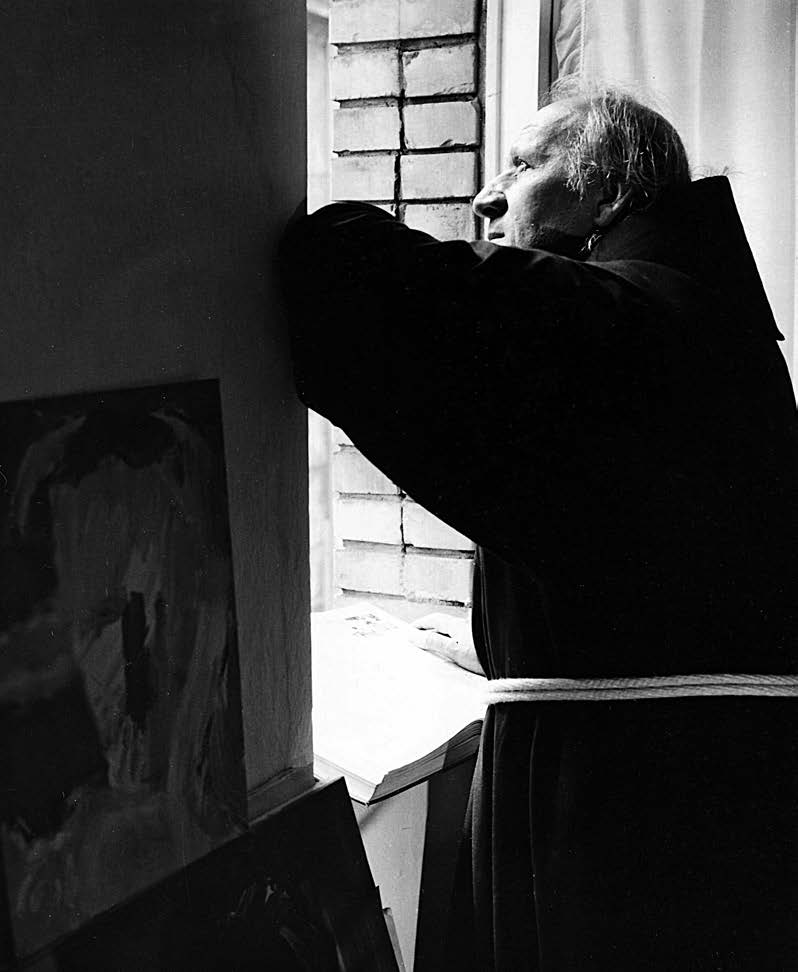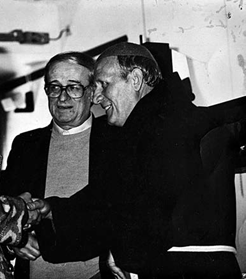
Father Nazareno Fabbretti was responsible for disseminating the works and artistic thought of Father Costantino Ruggeri, developing a deep friendship with him and admiring his work and creative commitment. At the Sacred Art Research Studio in the Canepanova convent, he carried a camera with him, which he used to document his brother’s works destined for chapels, churches, and sanctuaries. He was able to capture their charm as an authentic expression of a Franciscan soul, unique in its understanding of poverty, the essentiality of forms far removed from revisiting archaic languages and Mannerism, and the love of truth and simplicity. He rejoiced in the glories of nature in stained-glass windows, in the vigorous treatment of material.
On the occasion of the eighth centenary of the birth of Saint Francis, Father Nazareno shared with his brother the creation of a portfolio of twenty-four plates, executed by Father Costantino, dedicated to the saint’s companions and commented with passages selected from Franciscan sources. Using the same criteria, they also jointly composed the volume Here is Perfect Friendship, enriched by twenty additional characters and biographical texts. We do not know how they came to identify the various characters and decide to include contemporary figures such as Gandhi, Don Orione, and Mother Teresa of Calcutta.
In several articles, Father Nazareno recognized Father Costantino’s portrait of Saint Francis as “one of the most intense and faithful interpretations, psychologically and spiritually: the face of Francis for the man of today and of all time.” During a forced break for health reasons, Ruggeri turned to his brother to write an autobiography. A lively interview then took shape, culminating in the publication of the book Just One Flower. Genesis of a Christian Artist, in which one senses the strong friendship that had gradually grown between them, thanks also to his friend’s profound understanding of the artist friar’s unique character, thought, and achievements. In them, Father Nazareno saw “a lived, not theoretical, response to the conciliar liturgical reform and to the free and faithful inventiveness that the ‘new temple’ demands from ‘worshippers who worship in spirit and truth.'”
1964
On the walls of churches the bliss of poverty
“Fiamma Nova”, a. XXIX, n. 12, dicembre 1964
He doesn’t seem to want to speak, but all it takes is the ability to insist and his words will touch your thoughts as his hands touch marble, clay, crystal, concrete, and steel: with delicate firmness, with passion and love. He is a painter who has won two prizes—the San Fedele and the Marzotto—but he is a friar who has put painting aside for several years to devote himself to the general problem of sacred art in Italy. He doesn’t belong to any school or circle, although he is by no means wild.
But he never has enough time to do, that is, to offer the most demonstrative “arguments” of what he seeks, what he wants. He is a friend of courageous architects like Figini, and of masters like Minguzzi, whom he boundlessly venerates and admires; but you will never find him at “viewings” or at meetings of exquisite culture. He has things to do, and does, from morning till night.
Return to the Catacombs
Only when provoked does he also use words. At first he begins hesitantly; then he warms up, and what he says ends up shining like the famous polychrome crystals of his bold stained-glass windows. It was while listening to him, on one of these October afternoons, that I felt the urge to write a sort of “psalter of the sacred art of our time”: it would be enough to collect and arrange the things Father Costantino Ruggeri says; you would have the most passionate and well-documented explanation of everything he does. Perhaps he doesn’t realize it at all, but in Pavia, in the Franciscan convent of Canepanova, where he has lived for years, the most coherent and courageous phase of the “revolution” in Italian sacred art has begun. In this sense, he is interested in painting and sculpture, architecture and liturgy. Sacred art, for this red-haired, light-eyed friar from Brescia, is a return to the expressive essence of the catacombs, with the added touch of light. But it is also a return to poverty: poverty as a virtue, as a state of mind, as an inner clarity to read and decipher the secrets of things, of light as well as of matter; poverty in walls and in spirits. Only under this condition is it possible, according to Father Costantino, to build churches that encourage prayer, and to be immediately understood and accepted by all who must pray there, clergy and people alike.
“Do you understand that a stone church can become an obstacle to the living Church formed by the community of the faithful?” he tells me, beginning his wonderful outburst. “Certain modern churches (just trendy churches) can, for a long time, jeopardize the evangelical penetration of contemporary society. Even the world of ‘economic miracles,’ despite appearances, when it approaches God, has no desire to find itself underfoot with the pomp, riches, trappings—that is, the hypocrisies it has already encountered in daily life. It desires and seeks the absolute opposite: simplicity, essence, the minimal material sign that helps it rise to the plane of mystery and breathe within it, that is, to pray. The very walls of the church must be able to preach the beatitudes to these people, hungry and thirsty for the spirit and beauty: poverty, purity, simplicity.”
Father Ruggeri is a poor man who became even poorer by wearing the Franciscan habit from childhood. The criterion of his art is also the commitment of his life as a priest and religious. The two chapels he has thus far been able to shape, at least in part, according to his dreams (the church and crypt of the seminary in Mantua, and the chapel of the Franciscan study in Varese) demonstrate that his spirit and his criteria have merged perfectly, and that his aesthetic talents have supported and expressed the young Franciscan’s renewing and liberating intentions. The altarpiece in the chapel at Linate Airport, the stained glass window in the Church of Pioltello near Milan, and the large polychrome crystal cross at the Madonna dei Poveri in Milan are already highly qualified examples of a coherence and essentiality rooted in the Gospel. Father Ruggeri was born in Adro, near Brescia, and over the years has always followed a path that has grown in rigor and religious meaning.
He had already seen the moon.
When he began painting, the friars were scandalized by his “monsters”; Then they let him do it, thinking he was obsessed; but they soon had to give in to the interest of critics, the recognition of juries, and the growing number of commissions. Moreover, the exhibitions the painter friar has held in Genoa, Milan, Biella, and Brescia demonstrate that he isn’t someone who follows a “trend,” but precisely the opposite: an artist and a priest who has something truly his own to say, and only in that way can he express it.
If he is granted, as is hoped, the opportunity to work on the new chapel of the regional seminary in Bologna, and when the works he conceived, in collaboration with the architect Figini, for the new large church that Milan intends to offer
Visiting Paul VI will truly reveal the talent, inspiration, and fidelity of this solitary artist, reserved for the more internal than external forms of his art. His speech is not without controversy; but to avoid confusion, Father Costantino offers his work, what he has done so far, and what he intends to do. When he saw the photographs of the moon taken by Ranger VII, he realized he had treated the material, on the walls of his gilded bronze tabernacles, as if he had already seen the moon: the same material, the same modulations; as if to say the execution of the motto of the Apocalypse: “New lands, new heavens…” And all with simplicity, without boasting, without provocation.
Only when he sees opulent and absurd churches, ugly as well as needlessly rich, does the gentle friar lose his temper: “Certain monumental churches serve the vanity of men, their lust for exhibitionist power, their thirst for money, more than the glory of God and the joy of man. God, through the Incarnation, chose, not by chance, the condition of poverty, a humble abode: and the Christian temple, which offers him crucified for the adoration of the faithful, can never be too rich without somehow betraying this perennial mystery. What I say I found in Saint Basil, in Saint John Chrysostom, they are not new. But they are forgotten things, and it is not bad to remember them. For example: a rich church in a poor neighborhood: it is blasphemy, in my opinion. Especially if they are the ‘churches of the masters’. The church must be beautiful, rich in beauty, not in provocative materials. Usually, the more materially rich a church is, the uglier it is. It would be enough Look at the luminous poverty of our oldest churches, to ensure that the man of our time finds his home in the House of God.” On this theme, it is difficult to stop him: “Luxury in the house of God! Let us learn to honor Him as He desires, not as we imagine He desires. Let us make churches poor, simple, luminous, austere, but alive and true. The liturgy begins with this form of living beauty. The liturgical function makes sense, after all, if it fosters encounter and conversation with God, not if it reaffirms a social and religious classism even next to the altar.” Everything he says, Father Ruggeri does, he tries to do. And those who gave him the freedom to do so have not had to regret it. The Bishop of Mantua confessed to him that he prays well in the seminary chapel, that the things of the “informal friar,” as they jokingly call him, “are up,” are going well. And the seminarians are enthusiastic. That is what matters. The rest will be increasingly revealed, both nationally and internationally, by the actions of this candid and passionate Franciscan.
1965
The work of Friar Costantino Ruggeri
“Chiesa e Quartiere”, n. 32, gennaio 1965
When approaching the artistic work of Father Costantino Ruggeri, the element that immediately surprises and persuades is the unity of all the elements, the formal and functional correspondence between the individual works and the complex building of which they are part. Since these are churches, the obvious consequence is their liturgical value: immediate, dynamic, and exemplary. It is clear that this does not result in personal research and experimentation. Experience and research are, for Father Ruggeri, a complex starting point, rather than a point of arrival. If there is controversy, and there inevitably is in a work of this kind, it arises from the facts, the conclusions, a given style, and a specific language. Style and language necessarily raise a series of comparisons whose stimulating value cannot escape anyone. This is not to say that Father Ruggeri doesn’t engage in polemics—at least, he argues and rejects the entire malpractice of art that insists on calling itself sacred—but he never argues for polemics’ sake, never accepts that words can somehow replace facts.
Father Ruggeri has no illusions about the usefulness of academic debates, which can address the most delicate and pressing issues of art in general, and sacred art in particular. This case, therefore, must be approached taking into account, first of all, a fundamental condition, which certainly doesn’t replace talent, for there is no need for it, but which explains the strength of these talents’ identification with the reality of the subject matter on the one hand and with the most courageous liturgical context on the other: the fact that Father Ruggeri is a priest and a Franciscan.
He never approached a work without first considering the overall problem of relationships with “others” (in this case, with God and with the faithful). The “others,” however—as is clearly evident in the chapels that Father Ruggeri was able to shape with a certain freedom of action—are not so much believers as non-believers. Certain fundamental reasons and justifications for Father Ruggeri’s work acquire—in this climate of the Council and liturgical reform—an “ecumenical” aspect and value, in that the Christian temple, adapting to the yearnings of an era, expands precisely as it articulates itself in the mystery and precise dialogue of the Christian liturgy, in a dialogue that can always be open to all men. The Church, as Father Ruggeri understood and shaped it, is by no means the place where, often in good faith or bad, for centuries, a certain unbearable “religious classism (if not racism)” has expressed itself, more than the intimacy of the Christian family: the classism of those privileged by the truth, to the scorn and humiliation of those deprived of that same gift. The stones of many temples, even impeccable from the standpoint of a valid aesthetic in itself, have become, in the hands of some, weapons with which to stone the faith, hope, sadness, and doubt of those who do not believe enough, of those who dared to doubt or not join in the Christian song of adoration.
Entering the chapels curated by Father Ruggeri means coming into contact with a reality that may not be understood, accepted, or shared, but which never indulges in ambiguity, never uses allusive language, never winks at the initiated to force the “profane” to feel as much of a stranger as possible in the very house of the “unknown God.” Father Ruggeri’s churches are, in short, never churches for the privileged, but rather churches for responsible people, churches for free and aware believers.
Father Costantino Ruggeri is not an artist who improvised a form and style by sensing in advance the inevitable direction of art and liturgy in the future. His work is the fruit of a silent fidelity to the very inspiration of adolescence and the struggle of maturity. Beginning in the school of Mario Sironi, and expressing himself primarily, until 1959, in paintings, over the years he gradually became more and more acclaimed and increasingly passionately oriented toward sacred art as a Christian temple.
As a painter, after exhibiting in numerous solo shows, from Genoa to Milan, from Brescia to Rome, from Mantua to Varese, he entered the mainstream critical acclaim with results that might have seemed more than flattering to an undemanding artist. He also won two notable prizes, the Marzotto and the San Fedele (the latter shared ex aequo with others), both in 1954. Nor was there a lack of interest from foreign critics. At this point, Father Ruggeri put painting on the back burner and set out to conquer (there are no other suitable words) some spaces where he could finally fully exemplify the concept of Domus Dei that had been maturing in him. Up to now, it has always had to accept prefabricated spaces, with obligatory topographical situations and lighting conditions;
Even within these limitations (as happened with the Chapel of the Seminary of Mantua and that of the Franciscan study in Varese), the Franciscan has always managed to express almost everything he wanted. The results have been not only formal confirmation, but also successful “proselytism” within ecclesiastical circles themselves, which, as everyone knows, are always the most tenacious in surrendering, the most happily enslaved by bad taste. The Rector of the Seminary of Mantua (and the Bishop of that city himself), the superiors of Varese, the seminarians, and the young Franciscan students were the first and most qualified witnesses to the success of Father Ruggeri’s liturgical artistic experiment. All have affirmed that in his chapels “one prays” and that his “work” holds up. These admissions, for those familiar with the prevailing taste in certain circles, are downright “revolutionary.” A sign, however, that the eloquence of facts always surpasses any polemical logic. But presenting finished works, demonstrating how, for example, even a chapel devoid of any “figure” in the traditional sense, with the exception of the Crucifix on the altar, can inspire prayer and meditation, without distracting or dulling the faithful’s most dynamic spiritual responses, is what can and must be done. Father Ruggeri maintains that there is, even in Italy, much more freedom regarding sacred art than one might think. There are enlightened bishops, highly sensitive church rectors, respectful of an era and the artist’s concepts; above all, there are young priests and seminarians who never begin with preconceptions and are willing to embrace every sincere experience, even that which may seem most advanced. If many artists fail to push, to seek, to provoke (since even sacred art participates in that “Christian scandal” that coincides with the very life of Christianity), this is not due to a lack of freedom, but rather to the aridity, sterility, and impotence of certain artists—men of calligraphy, capable of detail but not of organic and universal conceptions, capable above all of taking risks on their own, without involving authority from the outset.
In this sense, Father Ruggeri was undoubtedly helped by his early experience as a painter in a convent. Faced with his “monsters,” his fellow friars immediately tore their robes, at first. They were too accustomed to chapels as clean and soft as bedrooms, to images of Christ, the Virgin, and the Saints that were rosy, pathetic, and tearful, in short, justifying all the ambiguities of a piety and a liturgy that were more static than dynamic, more passive than active. Only with time did they surrender, before their very eyes did the “monsters” begin to decipher them, unsettled by certain stark and effective signs, by certain bursts of color that spoke volumes.
Today, few smile at Father Costantino’s work; and quite a few are proud of it, without letting it show: a friar who is commissioned for entire chapels, who wins two famous prizes, who exhibits throughout Italy, is at least a respectable achievement. But above all, they have accepted, sooner or later, at least in part, the very world of the artist-friar. This means that even in preconceived and initially rejected—if not downright polemical—circumstances can be clarified, revealing the necessary “novelty” precisely where, if not the classic “patrons” of our time, certainly the executive authorities of the “commissions,” are being formed (or deformed). It is important to note, in Father Ruggeri’s conventual experience, the significance of such a phenomenon. Before shaping stones and crystals, Father Ruggeri, with years of candid and joyful patience, shaped the people closest to him. At the very least, he sowed in them the doubt that all sacred art accepted until now is “beautiful.”
But those “converted” by Father Ruggeri’s art are perhaps unable to explain the most intimate and profound reason for their “conversion.” Even though they are Friars Minor, followers of Saint Francis, it is likely that they will only later understand that one of the fundamental explanations of their brother’s phenomenon lies precisely in the Franciscan essence of his labor and the spirit that animates it: that is, poverty. Indeed, it is in his confrontation with Christian and Franciscan poverty as a form of interior and exterior freedom that Father Ruggeri recognizes the spiritual strength of his own endeavor, and the essential necessity of all sacred art, in every age, but especially today. Father Ruggeri spent many months in the catacombs, deciphering the symbolic nature and expressive power of the essential symbols of early Christianity. He also wrote—on these very pages—a well-documented essay on the results of his research. He discovered, among other things, that the “cemeterial” nature of the catacombs inherently dictated essentiality, supreme simplicity, in the artistic ornamentation
of life confronting death in the name of faith. Simplicity as poverty. And precisely because that art was simple, it alluded with supreme effectiveness to the “dialogue” between God and the deceased, but also to the “dialogue” between the deceased and the living, and between the living and God, to whom the deceased led them in prayer and in the hope of the Resurrection. Father Ruggeri’s essay concluded with these precise words: “On the walls of the catacombs, the first Christians entrusted a surprising legacy of prayer, joy, and hope to a few sparse and unadorned signs, which reveal no acumen of observation of the surrounding world, exuberant imagination, precious colors, or bold compositions. Yet these signs are transfigured by a religious ardour, by a sense of perpetuity and timelessness that moves us and transports us to the realm of the purest mysticism. And is it not perhaps this possibility and intensity of dialogue that makes works so distant in time contemporary?”
Here is poverty as the stripping away of the superfluous, as the transparency of symbolism, as the essentialization of the religious mystery, which, being “ineffable,” that is, inexpressible in its totality, requires, to be expressed effectively, the “minimum,” not the “maximum,” of expressive means. From a conversation with Father Ruggeri, I was able to glean these observations, which I transcribe verbatim, for their formal-liturgical-social explanatory value and for the provocation they, in complete serenity, are capable of provoking.
We must be very careful: the stone church can often become an obstacle to the living church. Certain ‘modern’ churches (trendy churches!) can compromise the evangelical penetration of contemporary society for a long time. The very walls of the church must preach the evangelical beatitudes: poverty, purity, simplicity. It is an injustice that there are gigantic churches in certain neighborhoods, while immense suburbs lack poor churches. We must pay more attention to the radiant poverty of our ancient, exemplary churches, if we want the man of our time to rediscover his own home in the house of God. And we, who often defend the very legitimacy of luxury in the house of God, under the pretext that He is the master of all things, as if He Himself, in Christ, had not given us the measure, the example, the very style, I would say, of what He wants, of how He wants it, of how He demands that men honor Him in worship. Let us learn to honor Him as He desires, not as we imagine He desires, St. John Chrysostom.”
It is in this last thought that we must seek the rationale behind all of Father Ruggeri’s artistic activity: it is a passionate quest to find God’s own vision of his temple, and of the new Christian liturgy, which can no longer be the golden and triumphantly material one of the temple ordained by God himself for Solomon in the Old Testament. What do we want from our artists? ‘We want,’ Father Ruggeri replies, ‘simple, austere, living, and authentic churches.’
And here is the intuition that underpins the entire artistic-liturgical conception of this passionate witness to sacred art: light. A return to the essentiality of catacomb art, with the added bonus of light. Anyone familiar with the stained-glass windows of Mantua, Varese, and Pioltello, designed, assembled, and finished by Father Ruggeri himself, all on iron and concrete frames, in pure interplays of color, knows what he means by the very principle of his modernity, which is precisely “with the addition of light.” In those windows, there is not a single figure; they are simply colored crystals taken directly from the source, that is, from the castings of the Murano glassworks; they have been juxtaposed, “played” according to allusive relationships of light and color to convey the mystical effect of the space they serve as a wall, as in Mantua and Varese. “Light,” Father Ruggeri continues, “is the great conquest of our age; the church must be the very home of light. Many of my artist friends have told me, after entering ‘modern’ and ugly churches, that from now on they will go to pray in the woods, or by the river. I have not been able to prove them wrong. We need to rediscover simplicity, to rediscover peace and be capable of joy. This is morality: in the house of God, understood in this way, everything manifests itself in its authentic essence. Brick is brick, iron is iron; wood is wood; stone is stone; and even cement, this poor relative of other materials, yet which so vigorously expresses the anxieties of our time, is itself. Poverty, even from this point of view, will become the healing law that alone can free us from formal deception, and bring everything to its maximum expression, and to its best performance. Liturgical functionality only makes sense if it fosters dialogue and the encounter of man with God. This
the place is terrible, it is written in the Bible; and again: How lovely are your curtains!: ‘terrible’ solemnity and persuasive ‘loveliness’: this is the inseparable pair that we must harmonize. From all this, it is clear, for those who know what Father Ruggeri has already done, that more and better can be allowed him in the future. Father Ruggeri’s dream is, in fact, to have a church at his disposal, where he will not have to be conditioned by equivocal pre-existing environmental situations. This may have served as a stimulus in the past, but it would only be a limitation in the future. The “dream”, currently, as far as I know, consists above all in the hope of having the future chapel of the Regional Seminary of Bologna at his disposal. A new contact of this religious artist with the most qualified ecclesiastical world – and precisely in a courageous and fruitful area such as that created by the liturgical revival led by Cardinal Lercaro – would be a unique opportunity for this pioneer of the ‘new’ sacred art. And a work like the one he He conceives of it as something that could only be resolved through a happy “integration,” even if indirect, of the pedagogy and religious and aesthetic formation imparted in seminaries.
One of the current issues that Father Ruggeri is most concerned about is that of church furnishings. Most of them are patently grotesque, anachronistic, the exact opposite of the simplicity and intensity they should convey. This too will be an interesting experiment, which could revolutionize the most deadly sector of bad taste: that of expensive and triumphant “garbage.” Everything needs to be redone, in a certain sense: candlesticks, vestments, accessories.
When people rediscover the transparency of things in the Christian temple, they will begin not only to understand, but to love, accept, and adore the mystery of God. Only then will the church fit into the dramatic and stimulating life of other human homes, without appearing eccentric or grotesque, as it too often does. It will once again be the home of man as a friend of God, and of God as a friend. of man.
Everything that entails such an ideal and commitment signifies the only true, legitimate “revolution” possible, even in Italy, in the field of sacred art. We need men who act, who believe, who do not wait for encouragement and approval. But before a new canonical legislation can be ready to regulate the relationship between art and worship, let’s provide legal scholars with courageous and living raw material so as not to codify the obvious, the ugly, the useless, the pompous.
Father Ruggeri is not exempt from criticism (he is not a true artist); and here we have not attempted a specific, critical examination of his work, his style. Rather, we have highlighted a “human case” of extraordinary, controversial, and interesting interest. Because it is not just ideas that sacred art needs in Italy: it needs people. This is certainly one of them.
1964
The revolutionary of sacred art
“Orizzonti”, n. 37, 18 ottobre 1964
Father Costantino Ruggeri was violently indignant at the rampant bad taste in many churches. Then his laborer’s hands began to twirl, creating art as he saw it: a return to the catacombs, more of a triumph of light and color. His brothers called him “the informal friar,” but with a very affectionate irony, just to hide an admiration that had grown steadily over the years. Beginning in Mario Sironi’s school, Father Costantino Ruggeri, a young Franciscan with red hair and light eyes, calloused hands, and tenacious enthusiasm, gradually set aside painting—in which he nevertheless recognized his true artistic vocation—to devote himself to the comprehensive and total problem of sacred art in Italy.
Father Ruggeri writes little, and does much. He believes above all in facts. Just as he wasn’t overly flattered by two of Italy’s major painting prizes—the San Fedele and the Marzotto—won in 1954, neither do he become depressed by his fellow friars, the faithful, and the critics who, though fewer and fewer, continue to rend their garments before his works. What matters most to him is action. Faced with facts, everyone must accept reality, or at least discuss it.
It’s not that Father Costantino doesn’t suffer from robust and violent indignation. Certain Catholic trash, certain bad taste rampant in our new and old churches, throw him into a frenzy. Then he unleashes his anger, with salutary iconoclastic violence, against those who deserve it. But the storm always lasts a short time. Suddenly, the Brescian friar (born in Adro, near Brescia, in 1925) changes the subject, twirls his beautiful laborer’s hands, and a different tune begins. “There’s no point in arguing. The important thing is to get something done. The bad taste, the adulteration of sacred art, of walls, of even sacred furnishings,” he tells me, “cannot be dismantled except with new and beautiful churches. Never mind the old, ugly churches; they’re irreparable. But with the new ones, we should start off well; we should seize the opportunity, both taking into account the evolution of the complex sensibilities of contemporary man and accepting the liturgical reforms dictated by the Council as a valuable impetus. The Lord, in the Apocalypse, says that He demands and intends to make ‘new heavens and a new earth’: we should collaborate, starting by building beautiful churches, houses of man and of God at the same time, churches that don’t distract but that help us pray, that focus on the mystery, helping man not to understand it but to adore it with love.”
“And you,” I ask him, “have you already built as many churches as you would like?” “Not entirely,” he replies, “because until now, I’ve always dealt with pre-established environments, which I accepted as they were, only being able to apply and experiment with the best of my own perspectives. This happened in the chapel and crypt of the Mantua Seminary, in the chapel of the Franciscan study in Varese, in the Church of Pioltello, near Milan, and in the church at Linate Airport. I haven’t yet been offered the great opportunity of a church all to myself. If I really am entrusted with the chapel of the new Regional Seminary in Bologna, I think it will be a very interesting experiment for me. Above all, I will feel at ease with the works entrusted to me in the new large church that is about to be built in Milan in homage to Paul VI: I’ll have to create the doors, the pulpit, the altar, the crucifix, the furnishings, the stained glass windows.” “How come you decided to tackle the problem as a whole?” Frankly, because I was tired, and humiliated, of hearing my good friends tell me that having entered certain churches, they had decided, from now on, to go and pray in the woods or by the river. Some of my friends, especially among the artists, may be hard to please, but it is unfortunately true that some of our churches, old or new, are impassable, unsightly, unbearable. Needlessly rich, absurdly false, totally capable of discouraging those who truly seek God, they are a daily education in bad taste, first and foremost in bad religious taste. And worse than ever if certain believers feel comfortable there: it means that their concept of God has already become distorted. I believe these are people who, without realizing it, address God formally. It is pointless to design a new altar, or make beautiful candlesticks, or dare to create a truly modern crucifix, and perhaps insert all these things among all the other very ugly things. We must address the entire and complex problem of sacred art, accept the errors that are made. They are facts, and make them reasons for humility before the mystery of faith and art. Before the Church and art can be completely reconciled, as Paul VI hoped for last May 7th in the Sistine Chapel, both churchmen and artists will have to atone together for their sins of pity
prudence, bad taste, hypocrisy, perhaps even a lack of faith. Men like Figini in architecture, Minguzzi in sculpture, Manzù, and so many others can reopen the discourse on art, but we in the Church must prepare for them environments, spaces, and climates that will prevent them from retreating.
“How would you summarize the new sacred art?” “Above all, as a return to the Catacombs, with the addition of light. The Christian art of the Catacombs is essential, but not crude: it is the most refined, if you will, that exists. Much of the most courageous modern art harks back to the Catacombs, even if it doesn’t know it. We should learn to make the mystery simple, the ineffable adorable, by adding all the light we are capable of. The materials of catacomb art typical of the architecture of our time, such as concrete, glass, and iron, allow for the most daring and legitimate ways of expressing the inexpressible. I discovered it with difficulty, but I was compensated for everything. In the large stained-glass windows I created in Mantua, Varese, and Pioltello (entire walls), I didn’t create a single figure. But everyone told me that it’s about colors, light, and lyrical combinations that help us pray. I found trusting and intelligent people who trusted me, and this helped me more than anything else. The Bishop of Mantua told me that my works “stand up,” that is, that they help us pray, that they have a stimulating and truly liturgical function. I assembled with these hands tons and tons of colored crystals, which I personally went to Murano to select, in front of the daily castings. I couldn’t have had greater consolation. I think that even without returning to classic figures, light alone is enough to aid our prayer today.”
“This theme of light is one of the most passionate themes of Father Ruggeri’s art. He studied the symbolism of nascent Christianity in the Catacombs, but he immediately applied it to a triumph of light and color. He has brought to the brightest corners of creation the conclusions drawn in the sacred darkness of the Catacombs. He would even like the altar to be set against a real landscape, all contemplated through immense glass; it would also be a test to see if it distracts or helps. But he would like to take a risk. As far as he is concerned, so far Father Ruggeri has done everything himself, everything with his own hands. He has assembled immense iron frames, mixed tons and tons of cement, modulated tons of crystal. For the altar he does not seek combinations of precious marbles; rather, he chooses a real rock, not the one he barely squares, and then places it in its place: must it not be, in fact, only the symbol of Calvary, the bare rock on which the Lord immolated himself? Altars without tabernacles, because the altar is the altar of sacrifice, not the place of preservation. It is absurd, for Father Costantino, that, while Christ’s Sacrifice is mystically renewed, Christ is already sacramentally present on the same altar. The same goes for the sign of the cross. Father Ruggeri wants a single cross in a church, large, beautiful, and eloquent, to which, as is right, the entire sacrificial liturgy of the Church should hinge. Enough with the little crosses scattered everywhere, on the walls, the floor, the vestments, and the furnishings, as if the inflation of the sacred sign needed attention. There is no need to bless what is blessed, to consecrate what is already consecrated. Even for the Stations of the Cross, Father Ruggeri conceives it as a preparatory journey for the sacrifice of the altar, and he has it begin, if possible, outside the church, while the station of Christ’s death on the cross coincides with the altar itself. In a church, he has performed it literally on the ground, truly like a “road,” beneath the feet of the faithful.
“To what criterion do you base all this need for simplification?” “To the mystery, to virtue, to the problem of poverty. Not even sacred art today can avoid dealing with poverty. If it is true, as the Council reminds us, that our Church “is above all the Church of the poor,” let us begin to simplify everything in poverty. Everything will become more credible, more sacred, more true. All signs will be more effective, materials more transparent, meanings more immediate and evident. I speak especially of Franciscan churches, but the same applies to all. And it’s not just a question of aesthetic reasons, but also of spiritual ones. The mystery of God must not be presumed to be expressed with the maximum of material, especially if precious, but with the minimum: this seems to me to be an elementary law. And to give strength to all this, we must return to believing in poverty.
“In what sense?” “By giving churches the sign and freedom of poverty. The stone church can become an obstacle to the ‘living church’ formed by the community of the faithful. Certain modern churches (‘fashionable’ churches) can compromise the evangelical penetration of contemporary society for a long time to come. I believe that the walls of the church must protect
They themselves proclaim the evangelical beatitudes: poverty, simplicity, purity. For example, a rich church in a poor neighborhood; could there be a greater blasphemy? Inevitably, even if it wasn’t built with those intentions, it will seem like the church of the masters. Certain monumental churches serve human vanity, their lust for power, their thirst for money, more than the glory of God and the joy of humanity. We Christians should not forget, at least, that it is no coincidence that God chose, in the incarnation, the humblest realities as his flesh, as his dwelling place. Spiritual privileges are the most ridiculous, as well as the most abominable. It is abominable that in certain suburbs there are very rich churches, while even the most basic housing for the poor is lacking. The house of God must be rich, above all, in beauty; no precious material can replace a beauty that isn’t there.
“Don’t you think you’re a utopian, thinking and saying these things?” “I think so. But, if I may, no differently, for example, than Saint Basil, Saint Jerome, Saint John Chrysostom, who said the same things in the early centuries of the Church. I don’t boast of inventing these things: I merely repeat them. The ‘luxury’ of God’s house! We learn to honor Him as He wishes, rather than as we think He wishes. We want churches that are simple and simple, but alive and true; here lies the test for both artists and the faithful. Let us exploit light above all, the great conquest of our age.
“Do you think you’re being followed?” “And what does it matter? The important thing is to act. Then you get confirmation. One, for example, I had when I saw the photos of the moon taken by Ranger VII. I had already treated those volumes, those shadows and those lights, on the walls of my latest tabernacles. You have proof of this in these photos. I was always thinking of the ‘new heavens’ of the Apocalypse, and here is the confirmation. It doesn’t seem meaningless to me. The church must also have its liturgical function by promoting dialogue and encounter between God and man. And poverty is the healing law that alone can free us from formal deception, and bring everything to its maximum expression and maximum performance.”
And Father Ruggeri leaves. He is a man of few words; he has already spoken too much. Now he takes up his iron frames, his dazzling crystals. He is consumed by the need to make the friendship between God and man ever more effective, through the mystery and gift of an art that, for this stubborn friar, is “sacred” only if it is sincere and poor, in intentions as in materials. One can truly believe that if the “revolution” takes place in Italian sacred art, one of the first stops will be the Franciscan convent of Canepanova in Pavia, where Father Ruggeri first brought confusion and then the happy amazement of his own brothers. What is now written about him internationally, what he himself often writes in Italy’s most courageous art magazine – Chiesa e quartiere – leads one to believe that, truly, “this a revolution must be made.
1964
The revolutionary of sacred art
“Orizzonti”, n. 37, 18 ottobre 1964
Father Costantino Ruggeri was violently indignant at the rampant bad taste in many churches. Then his laborer’s hands began to twirl, creating art as he saw it: a return to the catacombs, more of a triumph of light and color. His brothers called him “the informal friar,” but with a very affectionate irony, just to hide an admiration that had grown steadily over the years. Beginning in Mario Sironi’s school, Father Costantino Ruggeri, a young Franciscan with red hair and light eyes, calloused hands, and tenacious enthusiasm, gradually set aside painting—in which he nevertheless recognized his true artistic vocation—to devote himself to the comprehensive and total problem of sacred art in Italy.
Father Ruggeri writes little, and does much. He believes above all in facts. Just as he wasn’t overly flattered by two of Italy’s major painting prizes—the San Fedele and the Marzotto—won in 1954, neither do he become depressed by his fellow friars, the faithful, and the critics who, though fewer and fewer, continue to rend their garments before his works. What matters most to him is action. Faced with facts, everyone must accept reality, or at least discuss it.
It’s not that Father Costantino doesn’t suffer from robust and violent indignation. Certain Catholic trash, certain bad taste rampant in our new and old churches, throw him into a frenzy. Then he unleashes his anger, with salutary iconoclastic violence, against those who deserve it. But the storm always lasts a short time. Suddenly, the Brescian friar (born in Adro, near Brescia, in 1925) changes the subject, twirls his beautiful laborer’s hands, and a different tune begins. “There’s no point in arguing. The important thing is to get something done. The bad taste, the adulteration of sacred art, of walls, of even sacred furnishings,” he tells me, “cannot be dismantled except with new and beautiful churches. Never mind the old, ugly churches; they’re irreparable. But with the new ones, we should start off well; we should seize the opportunity, both taking into account the evolution of the complex sensibilities of contemporary man and accepting the liturgical reforms dictated by the Council as a valuable impetus. The Lord, in the Apocalypse, says that He demands and intends to make ‘new heavens and a new earth’: we should collaborate, starting by building beautiful churches, houses of man and of God at the same time, churches that don’t distract but that help us pray, that focus on the mystery, helping man not to understand it but to adore it with love.”
“And you,” I ask him, “have you already built as many churches as you would like?” “Not entirely,” he replies, “because until now, I’ve always dealt with pre-established environments, which I accepted as they were, only being able to apply and experiment with the best of my own perspectives. This happened in the chapel and crypt of the Mantua Seminary, in the chapel of the Franciscan study in Varese, in the Church of Pioltello, near Milan, and in the church at Linate Airport. I haven’t yet been offered the great opportunity of a church all to myself. If I really am entrusted with the chapel of the new Regional Seminary in Bologna, I think it will be a very interesting experiment for me. Above all, I will feel at ease with the works entrusted to me in the new large church that is about to be built in Milan in homage to Paul VI: I’ll have to create the doors, the pulpit, the altar, the crucifix, the furnishings, the stained glass windows.” “How come you decided to tackle the problem as a whole?” Frankly, because I was tired, and humiliated, of hearing my good friends tell me that having entered certain churches, they had decided, from now on, to go and pray in the woods or by the river. Some of my friends, especially among the artists, may be hard to please, but it is unfortunately true that some of our churches, old or new, are impassable, unsightly, unbearable. Needlessly rich, absurdly false, totally capable of discouraging those who truly seek God, they are a daily education in bad taste, first and foremost in bad religious taste. And worse than ever if certain believers feel comfortable there: it means that their concept of God has already become distorted. I believe these are people who, without realizing it, address God formally. It is pointless to design a new altar, or make beautiful candlesticks, or dare to create a truly modern crucifix, and perhaps insert all these things among all the other very ugly things. We must address the entire and complex problem of sacred art, accept the errors that are made. They are facts, and make them reasons for humility before the mystery of faith and art. Before the Church and art can be completely reconciled, as Paul VI hoped for last May 7th in the Sistine Chapel, both churchmen and artists will have to atone together for their sins of pity.
prudence, bad taste, hypocrisy, perhaps even a lack of faith. Men like Figini in architecture, Minguzzi in sculpture, Manzù, and so many others can reopen the discourse on art, but we in the Church must prepare for them environments, spaces, and climates that will prevent them from retreating.
“How would you summarize the new sacred art?” “Above all, as a return to the Catacombs, with the addition of light. The Christian art of the Catacombs is essential, but not crude: it is the most refined, if you will, that exists. Much of the most courageous modern art harks back to the Catacombs, even if it doesn’t know it. We should learn to make the mystery simple, the ineffable adorable, by adding all the light we are capable of. The materials of catacomb art typical of the architecture of our time, such as concrete, glass, and iron, allow for the most daring and legitimate ways of expressing the inexpressible. I discovered it with difficulty, but I was compensated for everything. In the large stained-glass windows I created in Mantua, Varese, and Pioltello (entire walls), I didn’t create a single figure. But everyone told me that it’s about colors, light, and lyrical combinations that help us pray. I found trusting and intelligent people who trusted me, and this helped me more than anything else. The Bishop of Mantua told me that my works “stand up,” that is, that they help us pray, that they have a stimulating and truly liturgical function. I assembled with these hands tons and tons of colored crystals, which I personally went to Murano to select, in front of the daily castings. I couldn’t have had greater consolation. I think that even without returning to classic figures, light alone is enough to aid our prayer today.”
“This theme of light is one of the most passionate themes of Father Ruggeri’s art. He studied the symbolism of nascent Christianity in the Catacombs, but he immediately applied it to a triumph of light and color. He has brought to the brightest corners of creation the conclusions drawn in the sacred darkness of the Catacombs. He would even like the altar to be set against a real landscape, all contemplated through immense glass; it would also be a test to see if it distracts or helps. But he would like to take a risk. As far as he is concerned, so far Father Ruggeri has done everything himself, everything with his own hands. He has assembled immense iron frames, mixed tons and tons of cement, modulated tons of crystal. For the altar he does not seek combinations of precious marbles; rather, he chooses a real rock, not the one he barely squares, and then places it in its place: must it not be, in fact, only the symbol of Calvary, the bare rock on which the Lord immolated himself? Altars without tabernacles, because the altar is the altar of sacrifice, not the place of preservation. It is absurd, for Father Costantino, that, while Christ’s Sacrifice is mystically renewed, Christ is already sacramentally present on the same altar. The same goes for the sign of the cross. Father Ruggeri wants a single cross in a church, large, beautiful, and eloquent, to which, as is right, the entire sacrificial liturgy of the Church should hinge. Enough with the little crosses scattered everywhere, on the walls, the floor, the vestments, and the furnishings, as if the inflation of the sacred sign needed attention. There is no need to bless what is blessed, to consecrate what is already consecrated. Even for the Stations of the Cross, Father Ruggeri conceives it as a preparatory journey for the sacrifice of the altar, and he has it begin, if possible, outside the church, while the station of Christ’s death on the cross coincides with the altar itself. In a church, he has performed it literally on the ground, truly like a “road,” beneath the feet of the faithful.
“To what criterion do you base all this need for simplification?” “To the mystery, to virtue, to the problem of poverty. Not even sacred art today can avoid dealing with poverty. If it is true, as the Council reminds us, that our Church “is above all the Church of the poor,” let us begin to simplify everything in poverty. Everything will become more credible, more sacred, more true. All signs will be more effective, materials more transparent, meanings more immediate and evident. I speak especially of Franciscan churches, but the same applies to all. And it’s not just a question of aesthetic reasons, but also of spiritual ones. The mystery of God must not be presumed to be expressed with the maximum of material, especially if precious, but with the minimum: this seems to me to be an elementary law. And to give strength to all this, we must return to believing in poverty.
“In what sense?” “By giving churches the sign and freedom of poverty. The stone church can become an obstacle to the ‘living church’ formed by the community of the faithful. Certain modern churches (‘fashionable’ churches) can compromise the evangelical penetration of contemporary society for a long time to come. I believe that the walls of the church must protect
They themselves proclaim the evangelical beatitudes: poverty, simplicity, purity. For example, a rich church in a poor neighborhood; could there be a greater blasphemy? Inevitably, even if it wasn’t built with those intentions, it will seem like the church of the masters. Certain monumental churches serve human vanity, their lust for power, their thirst for money, more than the glory of God and the joy of humanity. We Christians should not forget, at least, that it is no coincidence that God chose, in the incarnation, the humblest realities as his flesh, as his dwelling place. Spiritual privileges are the most ridiculous, as well as the most abominable. It is abominable that in certain suburbs there are very rich churches, while even the most basic housing for the poor is lacking. The house of God must be rich, above all, in beauty; no precious material can replace a beauty that isn’t there.
“Don’t you think you’re a utopian, thinking and saying these things?” “I think so. But, if I may, no differently, for example, than Saint Basil, Saint Jerome, Saint John Chrysostom, who said the same things in the early centuries of the Church. I don’t boast of inventing these things: I merely repeat them. The ‘luxury’ of God’s house! We learn to honor Him as He wishes, rather than as we think He wishes. We want churches that are simple and simple, but alive and true; here lies the test for both artists and the faithful. Let us exploit light above all, the great conquest of our age.
“Do you think you’re being followed?” “And what does it matter? The important thing is to act. Then you get confirmation. One, for example, I had when I saw the photos of the moon taken by Ranger VII. I had already treated those volumes, those shadows and those lights, on the walls of my latest tabernacles. You have proof of this in these photos. I was always thinking of the ‘new heavens’ of the Apocalypse, and here is the confirmation. It doesn’t seem meaningless to me. The church must also have its liturgical function by promoting dialogue and encounter between God and man. And poverty is the healing law that alone can free us from formal deception, and bring everything to its maximum expression and maximum performance.”
And Father Ruggeri leaves. He is a man of few words; he has already spoken too much. Now he takes up his iron frames, his dazzling crystals. He is consumed by the need to make the friendship between God and man ever more effective, through the mystery and gift of an art that, for this stubborn friar, is “sacred” only if it is sincere and poor, in intentions as in materials. One can truly believe that if the “revolution” takes place in Italian sacred art, one of the first stops will be the Franciscan convent of Canepanova in Pavia, where Father Ruggeri first brought confusion and then the happy amazement of his own brothers. What is now written about him internationally, what he himself often writes in Italy’s most courageous art magazine – Chiesa e quartiere – leads one to believe that, truly, “this a revolution must be made.