

African art and architecture, “wealth and new celebration for the entire human family””1
Ferdinando Zanzottera
The relationship between Father Costantino Ruggeri and African art is a complex one that involved him in his entirety as an artist, priest, man of culture, and “missionary with stones and bricks.” His first impact, certainly in his youth, was not direct, but rather through his knowledge and study of the European artistic avant-garde, which looked to the naturalness and formal syntheses of African art to achieve a renewal of its language.
His passion for many exponents of the avant-garde is well known, and numerous publications dedicated to them have found their way into his personal library over time. He was curiously aware of the attempts to emphasize emotional aspects, at the expense of the descriptive narrative of reality as it appeared, that characterized Expressionism, and those to separate artistic form from aspects of the natural world in abstraction, favoring a non-geometric expressiveness that valorized the subjectivity and spontaneity of the creative gesture. This interest remained constant throughout his career and led him to explore the work of numerous artists, including Matisse and Kandinsky, as well as the Abstract Expressionists, the Informel movement, and the Fauvist painters, among the first to take a significant interest in African art. It is therefore clear that the Brescian friar’s passion for the art of the African continent owes its origins to these artists, whose remarkable ability to express the evocative power of graphic expression was also appreciated, a skill most admirably expressed in Matisse’s portraits. A prime example is Madame Matisse, which the French artist created in 1913, with evident features reminiscent of the masks of the Punu people of Gabon and other African ethnic groups.
Father Costantino’s interest in the avant-garde, which in the 1940s was characterized by self-taught tendencies, intersected during his theological studies with the language of Franciscan printmaking, characterized by extremely simple and concise figurative graphics and the use of line drawings easily reproducible in large-scale, low-cost prints, achieving evocative, chiaroscuro effects. Numerous magazines and publications of the mendicant orders and the Franciscan Third Order, in fact, increasingly resorted to this type of visual communication, which, although it did not attract Father Costantino’s interest and acclaim, influenced some of his early works on a variety of paper media. Influences from his daily acquaintance with Franciscan graphics, from the highest art of the avant-garde and from the study of the ways of using poor materials observed in Matisse, who created splendid découpages in the 1940s and 1950s, are evident in Ruggeri’s early works, now preserved at the Frate Sole Foundation.
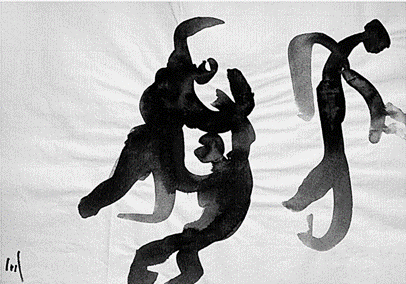
Untitled, circa 1943, ink on paper, 21 × 29.7 cm. Pavia, Fondazione Frate Sole
These are simple figures of men and women, painted in black, on sheets of paper that sometimes feature large, brightly colored frames (for example, green and red); their silhouettes reveal the friar’s interest in African culture. In the small series of paintings created “during the novitiate year” (1943), now collected in the archive folder titled “First Pencil Drawings,”2 not only does his attention to distant environments emerge, but the affinity with Matisse’s research is also evident, albeit with obvious shifts in scale, particularly with some of his specific works, including Dance (1909), Dance II (1910), and Dance (1913).
In these small paintings, with their strong, evocative rhythms and the essential expressiveness of vaguely abstract silhouettes, Father Costantino’s more or less conscious adherence to the research of numerous European artists who created monochrome human figures against light backgrounds, which found their peak expression in Matisse’s Blue Nudes series of 1952, appears. Unlike these, Ruggeri’s works are more introverted and less narrative; the dance depicted in one of them evokes in the viewer’s memory certain ceremonial battles in Central Africa. Elements of contact with the art of this continent are also evident in the polychrome work entitled Adam and Eve, created in 1954 and which won third place at the Marzotto Prize.
Using a more figurative language, in the second half of the 1970s the Franciscan “revived” his early study drawings of the Black Madonna for the church of Santa Chiara, which he designed in Nyamugari (Burundi). In it, he failed to achieve the same emotional pathos as in previous years, perhaps also due to other research and interests that had arisen.
From this more recent work, a well-known tempera on paper, dated August 3, 1978, depicting the Madonna Enthroned with the Child Jesus Seated on Her Lap, is part of the artist-friar’s collection.
In fidelity to avant-garde culture, during his postulancy and novitiate, which for him coincided with the dramatic years of the Second World War, Father Costantino focused on theological and religious formation, studying the history of the order, its founder, and the social complexity of the themes of missiology, enculturation, and acculturation. In addition to high ecclesiastical circles and Conventual theological schools, attention to Africa, and more generally to mission lands, was also given ample space in Franciscan publications, which were evidently well known to the young friar. It should therefore come as no surprise that missiological topics were frequently addressed in the periodical “Frate Francesco,” founded in 1933 and edited by the Roman Commission of the Third Order of Franciscans. However, it was administered in Milan by the Circolo di Cultura Francese and placed under the high patronage of Father Vittorino Facchinetti (Bishop of Nicio and Apostolic Vicar of Tripolitania).
This journal is certainly not a secondary one within the Franciscan educational landscape, also due to its openness to modernity, strongly influenced by Facchinetti. A cultured religious man, with a degree in medieval history from the University of Louvain and a degree in theology from Milan, he dedicated himself to evangelization according to the Franciscan spirit, employing all the means offered by new technologies. He was a pioneer of the telecommunications apostolate, open to different forms of art and cultural dissemination. He curated numerous artistic competitions, made two films on Saint Francis and Saint Anthony, conceived the well-known Italian Post stamps dedicated to the Franciscan centenary (1926), organised the National and Intercolonial Eucharistic Congress of Tripoli (1937) and became the “first sacred orator” on RAI5.
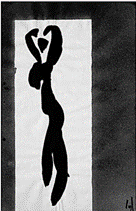
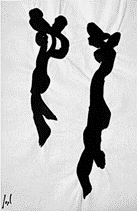
Untitled, circa 1943, ink on paper, 21 × 29.7 cm. Pavia, Fondazione Frate Sole
It is clear that many of his ideas, expressed primarily in the 1920s and 1930s, did not find a full correspondence in Ruggeri. However, he also learned from them an expressive freedom consistently oriented toward the search for truth, open to modernity. From Facchinetti’s culture and religiosity, for example, his father shared a love of good cinema and a propensity not to fear modern means of mass communication: radio, cinema, and television, as evidenced by the transliteration, in paintings linked to the Franciscan universe, of actors and public figures from the small and big screen. 6 This openness to modernity was not shared by all friars, but was much more widespread in cultured Franciscan circles than is commonly assumed. This is confirmed, as early as 1936, by Giuseppe De Mori’s invitation to readers and the Church, on the same pages of the periodical “Frate Francesco,” to employ all available means to evangelize the world and the land of Africa, including modern new telecommunications technologies. 7 In the same year, Francesco Aquilanti wrote in the same magazine:
It is not true that Saint Francis is opposed to knowledge and science. The friars must cultivate all their talents. He is decidedly averse to a certain type of knowledge, and that is bookish knowledge, which makes science and art ends in themselves. This creates cerebral people, perpetually disputatious Hamlets, prone to skepticism and despair […]. The Franciscan Rules have nothing rigid or immobile about them; they adapt to the times. The Franciscan is free and original. He possesses imagination and lyricism. 8
Father Costantino was further influenced by the debate promoted by diverse Catholic circles and by numerous bishops, who were personally committed to promoting a modern reflection on the value and meaning of evangelization and on the methods of encounter with different cultures and religions. This, in a Franciscan context, coincided with the recovery of the founder’s identity. Indeed, Saint Francis conceived of missionary preaching as “constitutively apostolic” and consistent with the charism of the fraternal experience founded in Assisi.
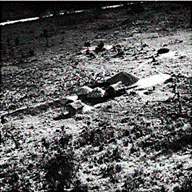
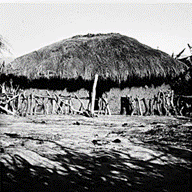
Ruyigi (Burundi), characteristic huts built of wood, straw, and mud. Photograph by Father Costantino Ruggeri, 1980. Pavia, Frate Sole Foundation
Ruyigi (Burundi), detail of a hut built of wood, straw, and mud. Photograph by Father Costantino Ruggeri, 1980. Pavia, Frate Sole Foundation
Among the leading figures involved in the debate and renewal of the Church’s attitudes were Cardinal Charles-Martial Allemand Lavigerie, Monsignor Alphonse Van Uytven, Archbishop Celso Costantini, and Archbishop Giovanni Dellepiane, who, in 1936, organized the first exhibition of African Christian art in Léopoldville. The latter was among the first to promote a movement within the Church to ensure that liturgy and sacred art fully responded to the needs of the culture of missionary lands. For him, in fact, culture and art could, and should, constitute a preeminent instrument of evangelization, and for this reason, calls for Europeanization were to be categorically rejected. In the monograph devoted by the magazine “L’Artisan Liturgique” to the Léopoldville exhibition, the monsignor urged respect for local artistic expressions. Under the impetus of the Church on the move, many religious orders from then on became involved in the promotion of “indigenous” art; particularly significant in this field was the experience of the Institute of the Franciscan Missionary Sisters of Mary, affiliated with the Order of Friars Minor since 1882, which gave rise to the collection of works now preserved in the Lateran Missionary Museum.
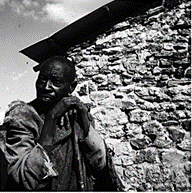
Ruyigi (Burundi), a village elder in front of a building constructed of local stone. Photograph by Father Costantino Ruggeri, 1980. Pavia, Frate Sole Foundation
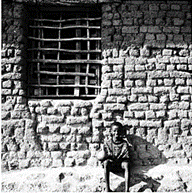
Ruyigi (Burundi), a child in front of a building made of sun-baked bricks. Photograph by Father Costantino Ruggeri, 1980. Pavia, Frate Sole Foundation
The debate of the 1930s, inevitably linked in part to issues of colonization, led to a maturation of reflections on art in religious contexts. This was expressed, not without some difficulty, also through the Congregation for the Propagation of the Faith, which clashed with the customs and building practices of many religious communities. Numerous authoritative voices were involved in the debate, which also included the movement born around the magazine “L’art sacré,” then edited by Joseph Pichard. This publication was well known to Father Costantino, who avidly read every article, and whose issues from 1952 to 1969 are preserved in his library. The Franciscan artist’s organic interest in the theme emerged after his priestly ordination (1951) and following his acquired pastoral autonomy, linked by the order to his vocation as a friar-artist. While he painted and consolidated his relationships with the Milanese cultural scene, centered around the Galleria San Fedele in Milan, which in 1951 hosted his first painting exhibition presented by Mario Sironi, he also established relationships with other important sacred art magazines, such as “Arte e Fede,” where his friend and fellow friar Father Nazareno Fabbretti would also be present.
In these years, the Holy Office and the Episcopal Commission for Pastoral Care, Liturgy, and Sacred Art of the French Church also expressed their views on the problems of the African continent and its missionary processes. These views were immediately highlighted in “L’art sacré,” which called for the elimination of stereotypical, industrially produced images in favor of more advanced and personalized artistic forms. During this period, the art of Africa and the Far East was not yet emblematic of inculturation, a term coined only in the 1970s to differentiate the new approach from previous ones, which had been referred to, in turn, as acculturation, enculturation, transculturation, accommodation, indigenization, and localization. However, already in these years, Father Costantino consolidated his interpretation of “primitive” art, with which he had interacted in the previous decades, also because they coincided with the publication of numerous volumes dedicated to the African art of specific ethnic groups and geographical areas. Ruggeri in fact came into contact with the studies of the historian and critic Werner Schmalenbach and consolidated his knowledge of West African masks through the studies of Leon Underwood, considered “The precursor of modern sculpture in Great Britain”10 strongly influenced by the formal language of the Cyclades Islands and African art, and also the author of several volumes on the art of the black continent, among which the most famous became Bronzes of West Africa, from 1949, and even more so Masks of West Africa, from 1952, also preserved in the private library of the Lombard friar.
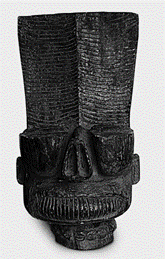
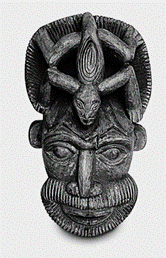
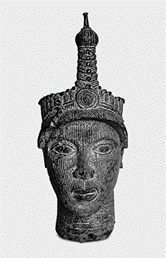
Headdress mask of the Batcham people of the Bamileké kingdom of northwestern Cameroon, otherwise known as the “chair mask.” Father Costantino Ruggeri Collection
Ceremonial mask of the Bamum people worn as a headdress by dancers. Father Costantino Ruggeri Collection
Bronze head of the Edo people of Nigeria, from the Ife region, depicting the Oba, king and religious leader. Father Costantino Ruggeri Collection
The 1950s and 1960s coincided with his growing interest in African art, now increasingly explored in its cultural-religious aspects and less in its formal and expressive implications. He also seemed to lose interest in strictly ethnographic themes, as evidenced by his personal collection of African art, built up through repeated purchases and acquisitions over the following decades. His readings from previous years, his participation in the cultural debate periodically revived by “L’art sacré,” which, in 1962, dedicated a double issue to African sacred art, revisited by the magazine “Chiesa e quartiere,” found interpretative synthesis in some of Father Costantino’s writings. In 1967, for example, he published a short essay in the magazine “Missioni Francescane,” in which he collected reflections on the art and architecture of the missions, calling them “quick notes” that emerged from his “summer wanderings.”
He wrote:
We must stop sending to the missions material discarded from our churches and sacristies, or the leftovers that are no longer sold in the shops of the temple merchants. I have seen statues of indescribable sloppiness and vulgarity in the mission churches, images that insult religion and good taste […]. Missionaries must be discouraged from having local artisans make copies of Western works of art and from presenting the figures of Christ, the Virgin Mary, and the Saints with our physical features. Doing so could run the very serious risk of religious racism, as if Christ, the Virgin Mary, and the Saints disdained having the face of a Black or Chinese person.
In these cases, simple but vibrant peoples are being diverted from their authentic cultural and human values […]. A worse problem is to foster the prejudice that everything Western, imported, is better than their own cultural and artistic heritage! It would also be a true offense to undervalue or disdain what is alive, genuine, and wholesome in a place or a people, in order to introduce foreign mentalities, customs, and traditions […]. As for churches, they must be built in harmony with the environment and with civil buildings.
The church must welcome the Christian community and therefore will be larger than a private home, but it must also fraternize with it. It should be built with the same materials, inspired by the same construction systems; the design should be entrusted to the most capable professionals in the country; in short, it should have the color and warmth of the nature that surrounds it and the sky that covers it. The church must be true, just, healthy architecture, from the land and the people among which it was born, and not some kind of strange spaceship landed there by chance. Sacred representations must adapt to the local language and symbolism […]. Local artisan design will provide liturgical objects, with shapes and materials customary in furnishing indigenous homes. In the missions, all elements of Christian sacred art must be the spontaneous and natural expression of the face of a land and the heart of a people, where Christ can be welcomed as a brother and not as a stranger.
This long quote exemplifies his developed position regarding the art and architecture to be created in mission places. This is a far cry from the interest in African art forms demonstrated in his early career as a painter and sculptor, now providing an opportunity for religious reflection in the Franciscan spirit, even before its aesthetic implications. It was a position that had matured over time, fully and succinctly expressed in the interview given to Father Nazareno Fabbretti in 1995, published in the volume Spazi di luce12, and shared with him during study trips to Franciscan missions around the world. In this process of reflection and exchange, the artist and priest from Brescia radically changed his interpretative approach to the art forms of the African continent, rediscovering a profound meaning, more directly connected to his identity as a Franciscan friar.
It was a journey of personal maturation, both cultural and critical, intertwined with numerous other factors related to the history of the order and his work as a friar-artist. In 1983 the General Minister, Father John Vaughn, launched the “Africa Project” which aimed to renew the charism and missionary impulse in a contemporary key.
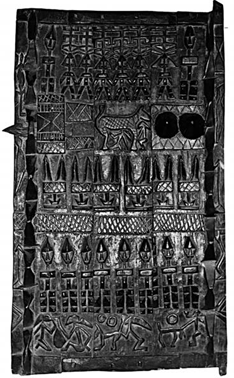
Door of a granary, or “house for storing grain,” on the Bandiagara plateau belonging to the Dogon people. Father Costantino Ruggeri Collection
The Minister and the General Chapter’s intention to involve only “adequately trained” confreres, willing to carefully study African languages and cultures, was a significant incentive for him to continue engaging with the continent’s art. This interest soon developed into a professional activity, with the commission to build three churches in Burundi in the late 1970s, entrusted to him by the Minorite Province of Genoa. In 1978, Father Costantino began designing the small church of Santa Chiara in Nyamugari (Burundi), whose construction began the following year and was completed in 1980. In the meantime, together with the architect Luigi Leoni, he began designing the church of San Francesco in Kayongozi (1979), whose construction began in the same year and was completed in 1983. Once this second adventure was completed, in the same year the Genoese Province of the Friars Minor entrusted him with the task of designing, together with Leoni, the branch church of Nyakayi, the work on which lasted from 1983 to 1987. During these years Ruggeri travelled a lot; He traveled to Africa, to Burundi, where he produced significant photographic reportages, precious testimonies of which remain in the archives of the Frate Sole Foundation. African art is almost absent or very limited in these photographs, while his interest in understanding the shared living spaces of the Burundian people is amply documented. His shots linger on the landscape, work and fishing tools, dugout canoes made from hollowed-out logs, local architecture, and moments of daily life. Although there are “ritual” photographs taken with the subjects posing, his predilection for “stolen” photographs is evident, in which the subject is portrayed with the spontaneous gestures of someone unaware of what is happening. These shots, however, also reveal the modesty and delicacy with which Father Costantino approached his “African brothers,” almost fearful of disturbing and “violating” them with his camera. Indeed, many shots are taken from afar, from behind trees, or with the subjects turned away. He then experimented with a personal photographic technique that allowed him to narrate his wanderings through Burundi without being distracted by his interest—driven by the commitment to building churches—in the humble architecture, fences, mud walls, and children’s drawings scratched into the walls. Simple children’s drawings, over which the friar lingered with joy, depicting aspects of everyday life (such as working in the fields and playing football) and the animals that populated village life (such as roosters, hens, and chickens), traced on walls that were important to Father Costantino, because “the blacks make the walls and roofs of their huts with extreme ease, singing. And they are beautiful walls […] The ‘poto-poto’ (mud) walls,” he added:
[…] Africans make them with their hands, that is, they shape them like human bodies. Those walls aren’t cold, angular, or anonymous. They’re man-made, not machine-made. Seeing them, you’re led to believe that the Creator, in shaping the first man, must have had the same innocence in his “hands” as these innocents. They have warmth, softness, elegance, and creativity. And you want to caress them.
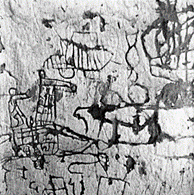
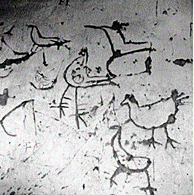
Ruyigi (Burundi), photograph of some zoomorphic graffiti on a village building (photograph by Father Costantino Ruggeri, 1980). Pavia, Frate Sole Foundation
Ruyigi (Burundi), photograph of some graffiti depicting men and animals on a village building (photograph by Father Costantino Ruggeri, 1980). Pavia, Frate Sole Foundation
His ability to interpret reality, which presented itself to him through photography, and his desire to fully understand Africa led him to radically change his attitude toward art and the continent. His notes are emblematic, demonstrating how, from simple everyday objects and elements of nature, he could draw inspiration to create new works of art or design architecture. He was continually amazed by nature, perceiving within it infinite creative possibilities. In all his travels, in Africa and the East, he met people, visited monuments, photographed, and recorded his impressions in large notebooks and albums, paying attention to every detail, even capturing the finished form of a church in a stone found on the ground. He held within himself with great freedom everything he saw; the gaze with which he photographed peoples, their architecture, their artistic expressions was not mechanically translated into figurative language, but was first and foremost a cultural embrace open to transcendence and artistic creativity. Through Africa and “black art,” Ruggeri learned to look with renewed intensity; in this way, everything he saw became a different declination of Saint Francis’s Canticle of the Creatures, regenerated by African man. During this period, he became deeply familiar with the languages of the “third world,” finding in them fruitful parallels with his own. He drew from it a kind of lifeblood that contributed to the explosion of his figurative imagination, allowing him to more deeply understand the reality assumed and exalted by his own human sensitivity. In some ways, his relationship with Africa, his experience in Burundi, and the opportunity to build numerous other churches, combined with the possibility of expressing himself through glass and humble materials, allowed him to experience his own Franciscan and artistic essence with renewed splendor. Without fear of contradiction, Africa became for him an occasion for reflection on his entire existence: a memory of the entire personal history of a man, friar, priest, painter, artist, and architect.
Perhaps for this very reason, he began purchasing masks from all over Africa. He filled his studio in Pavia with them and surrounded himself with them. He hung them on the walls, placed them on the beams, and arranged them on the floor, also collecting antique pieces of undisputed value. His substantial collection of approximately 200 works, now preserved in different rooms of the Canepanova convent in Pavia and in the rooms used by the Frate Sole Foundation, includes, to name just a few examples, Dogon bronzes, Cameroonian masks of the Bamum people, Coptic crosses and icons, Mandé and Dan artistic expressions, Bamileké chair-masks, “Atua Afungo” anthropo-zoomorphic masks from the north-western Grassland region, Guro sculptures from the interior forest area of Côte d’Ivoire, Dogon coin-bracelets, and other subjects.
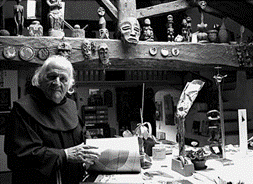
Father Costantino Ruggeri in his studio (2004). Pavia, Frate Sole Foundation
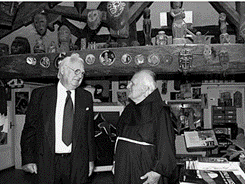
Father Costantino Ruggeri in his studio with Richard Meier (October 4, 2004) on the occasion of the presentation of the “Frate Sole” International Prize for Sacred Architecture to the American architect. Pavia, Frate Sole Foundation
He had his collaborators very briefly catalog them, but he did not ask them to study them. For each sculpture or mask, he had a photographic reproduction made and glued it onto colored cards. On the back of the reproduction, he wrote a very generic title (for example, “African statue,” “African mask,” or “African bronze head”), the material or technique used, the dimensions, and the precise location within his studio. 14 From these requests, it can be deduced that Father Costantino was not interested in the object’s provenance or its ethnographic value, but exclusively in its vague anthropological dimension. It was probably enough for him to relate to these objects because they were produced by Africans as such, not because they belonged to a specific ethnic group or social group. They were interesting to him as testimonies to an ancient and vibrant culture capable of creating objects of great expressiveness and evocative power. For this same reason, he did not distinguish the sculptures’ different functions; the collection also contained everyday African objects, such as a stool-headrest, a wooden spoon, a terracotta vase, a wooden bowl, and musical instruments.
This significant collection, which still awaits full appreciation and careful study, was for him a constant reminder of the encounter, in the Franciscan charism, of the Church with diverse cultures, in response to the challenges of the future prophetically announced by the Second Vatican Council. The objects scattered throughout his study testify to Father Costantino’s profound missionary spirit, which also shines through in his sermons of the 1980s, particularly the one he gave on the 20th Sunday of Ordinary Time, in which, referring to his travels in the East and Africa, he said:
Looking around me, I certainly saw significant signs of Christian faith and love, but also how many testimonies of our presumption, our vanity! Meanwhile, the barriers of race! For several centuries, Father Costantino Ruggeri in his study (2004). Pavia, Frate Sole Foundation Father Costantino Ruggeri in his study with Richard Meier (October 4, 2004) on the occasion of the awarding of the “Frate Sole” International Prize for Sacred Architecture to the American architect. Pavia, Frate Sole Foundation For centuries, ours has appeared to be the religion of white peoples, bearers of earthly civilization and eternal salvation to non-white peoples. Cultural barriers: we have brought the Gospel tied to a culture “ours,” profoundly foreign to the indigenous culture, and a liturgy of signs indecipherable to the daily lives of those people […]. Despite the evangelical spirit of the Second Vatican Council, there are many who still consider many traditions inviolable, perhaps venerable in the past, but now dead and harbingers of death. Many long for the old rites, the devotional practices now abandoned, and see in the liturgical renewal almost a deviation from the faith and a hint of heresy, at the very least, a weakening of religious practices.
Friends […] life is renewed. The Gospel is newness; the Christian must always experience an interior rebirth, as is the vital law of the Spirit that animates us. Those anchored to the past without the courage to face the present and the future withdraw into themselves, without looking to Christ who stands before them, on the paths of humanity, because He is always and only in the happiness and despair of humanity.15
1 C. Ruggeri, L. Leoni (a cura di), Spazi di luce, Elledici, Torino 1995, p. 67.
2 Archivio Fondazione Frate Sole, cartella “Primi disegni a matita”.
3 Collezione “I premi Marzotto”.
4 Collezione Padre Costantino Ruggeri. Opera pubblicata senza firma e data in A. Sabatucci (a cura di), Costantino Ruggeri. L’architetto di Dio, Skira, Milano 2005, p. 100.
5 A. Fappani (a cura di), Enciclopedia bresciana, La voce del popolo, Brescia 1978, vol. 3, ad vocem.
6 Per questo tema si rimanda al saggio di Maria Virtus Zallot presente in questo stesso volume.
7 G. De Mori, La vocazione africana di S. Francesco e l’Italia Imperiale, in “Frate Francesco”, IV, 1936, 4, pp. 205-208.
8 F. Aquilanti, S. Francesco e i tempi nostri, in “Frate Francesco”, IV, 1936, n. 3, pp. 161-168. 9 Voci Predicazione, predicatore e Missione, mandato, in E. Caroli (a cura di), Dizionario francescano, Messaggero Padova, Padova 1983, coll. 1413-1430; 1007-1022.
10 C. Neve, Leon Underwood,Thames and Hudson Ltd, London 1974, p. 2.
11 Dattiloscritto conservato nell’Archivio della Provincia Sant’Antonio dei Frati Minori in Milano. Appunto trascritto, sprovvisto di segnatura.
12 Ruggeri dichiara: “Il loro scopo [delle avanguardie artistiche] era diverso dal mio, essi si rifacevano alla vita e all’arte di quei popoli primitivi per uscire dalle secche della cultura europea. L’arte negra in modo particolare fu per essi fonte di ispirazione, quasi un ritorno alle origini per nuove ebbrezze di creatività. Pensa ad alcune opere cubiste di Picasso, di Modigliani, di Brancusi. Anch’io andai in Africa non però per scrollarmi di dosso la cultura occidentale, ma per farmi il cuore e gli occhi degli Africani. Lo ritenevo un fatto essenziale per operare con onestà in quel continente. Pensavo: ‘E certamente anche le opere che poi farò nel mio paese ne ricaveranno linfa, genuinità e slancio’”. Ruggeri, Leoni (a cura di), Spazi di luce cit., p. 67.
13 Ruggeri, Leoni (a cura di), Spazi di luce cit., 69.
14 Schedatura di queste opere presso lo studio dell’architetto Luigi Leoni, in cinque quadernoni ad anelli sprovvisti di segnatura.
15 Archivio storico della Provincia Sant’Antonio dei Frati Minori a Milano, Prediche di padre Costantino Ruggeri, quaderno manoscritto 5°.